
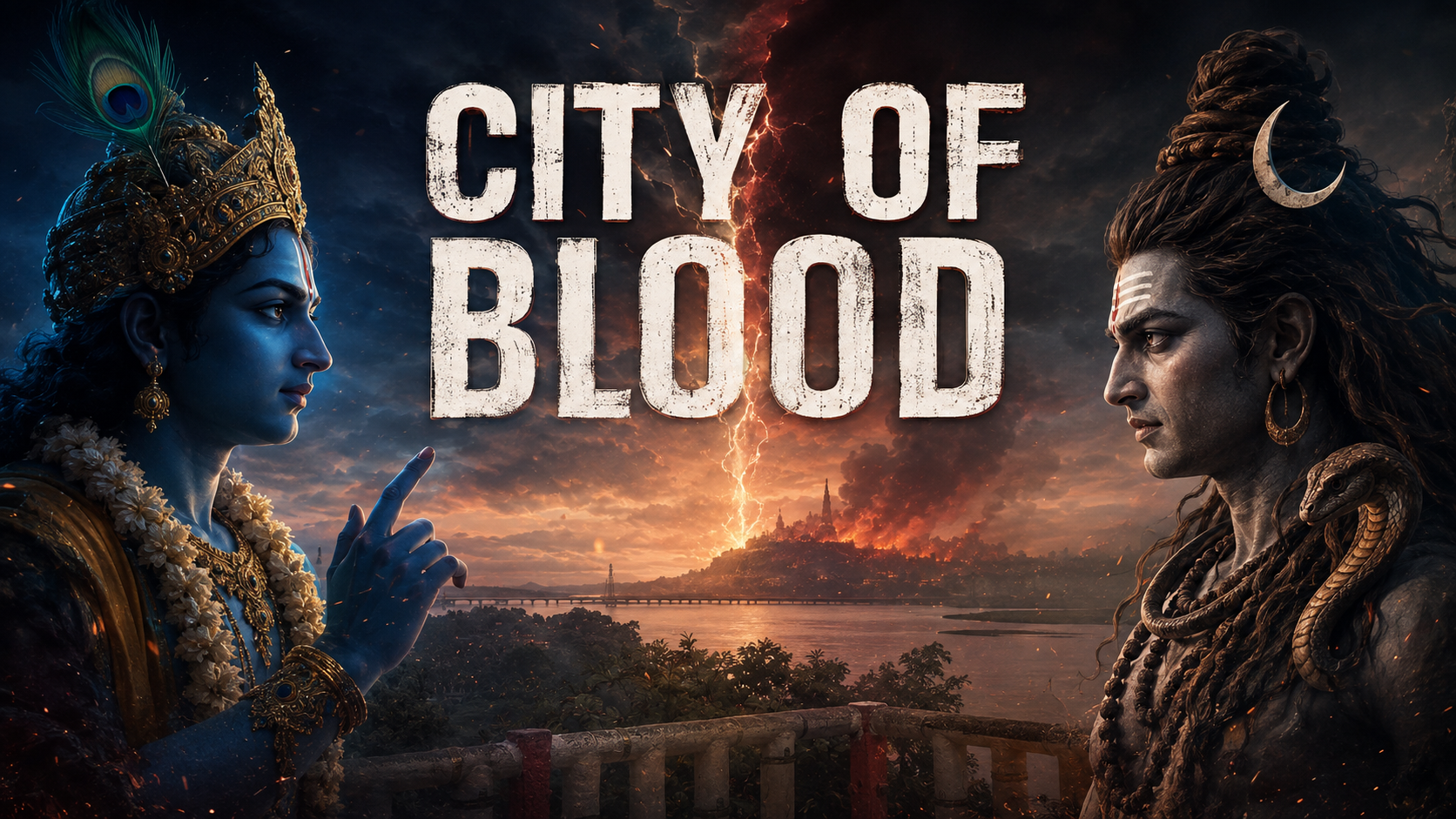
Tezpur is one of Assam’s most beautiful cities, sitting on the northern bank of the Brahmaputra with the hills of Arunachal Pradesh visible beyond it. Today, it is known for its landscapes, temples, gardens and archaeological remains.
But Tezpur has another identity — one rooted in one of the most dramatic stories of Hindu mythology.
It is traditionally known as the City of Blood.
At the same time, Tezpur is also known as the City of Eternal Romance.
The remarkable part is that these two seemingly opposite identities come from the same story.
It is the story of Usha and Aniruddha, the daughter of Banasura and the grandson of Krishna. It is also the story of Banasura’s devotion to Shiva, the arrival of Krishna in Sonitapura, and the legendary confrontation between Hari and Hara — Krishna and Shiva.
The story connects places such as Agnigarh and Mahabhairav with the legendary landscape of Tezpur, while the wider Sonitpur region contains archaeological sites that reveal a much older and independently documented history.
To understand Tezpur, therefore, it helps to look at three different layers at once:
mythology, local tradition and archaeology.
And that is where the story becomes particularly fascinating.
Why Is Tezpur Called the City of Blood?
The traditional explanation for Tezpur’s name comes from the Sanskrit-derived Śoṇitapura/Sonitpur tradition, associated with blood.
According to Assamese tradition, the city was the capital of Banasura, and it became the setting for a tremendous battle between Krishna and the forces protecting Banasura.
Assam Tourism describes Tezpur as the legendary capital of Banasura and connects its traditional name with the battle that followed after Krishna came to rescue Aniruddha. According to this account, the clash between Krishna and the forces of Banasura, aided by Shiva, covered the city in blood — giving rise to the association with the “City of Blood.”
This explanation belongs to the realm of mythological and regional tradition. It should not be confused with archaeological evidence establishing that an actual historical battle took place at Tezpur.
But the legend is not a recent invention.
The central episode is found in the Bhagavata Purana, whose Tenth Canto contains the story of Usha and Aniruddha and introduces it specifically as the story that led to a great battle between Hari and Shankara — Krishna and Shiva.
The Story Begins With Banasura
To understand why Krishna eventually came to Sonitapura, we first need to understand Banasura.
In the Bhagavata Purana, Banasura is described as the eldest of the hundred sons of King Bali.
Bali is an important figure in Hindu mythology, best known for his encounter with Vamana, the dwarf incarnation of Vishnu. Banasura inherited the strength and stature of this lineage, but he became especially famous for his devotion to Lord Shiva.
The Bhagavata Purana describes Banasura as a great devotee of Shiva. He possessed one thousand arms, and his devotion was so intense that he once accompanied Shiva’s tandava dance by playing musical instruments with his many hands. Pleased with him, Shiva offered Banasura a boon.
But the boon is often simplified in modern retellings.
The Bhagavata Purana does not simply say that Banasura was granted immunity from defeat.
Instead, Banasura chose something very specific:
he asked Shiva to become the guardian of his city.
Shiva agreed.
This detail becomes extremely important later.
Because when Krishna eventually comes to attack Banasura’s city, Shiva is already bound by his promise to protect it.
Banasura’s Thousand Arms and the Prophecy of His Defeat
Banasura eventually became proud of his enormous strength.
He complained to Shiva that despite having a thousand arms, he could find no worthy opponent to fight.
Shiva responded with a warning.
According to the Bhagavata account, Banasura’s pride would eventually be destroyed when he encountered an opponent equal to Shiva, and his chariot’s banner would fall.
This becomes an important piece of foreshadowing.
Banasura believes his strength is almost limitless.
But Shiva already knows that his pride will eventually be broken.
And the person who will do it is not yet known.
Enter Usha, Banasura’s Daughter
Banasura had a daughter named Usha.
The Bhagavata Purana tells us that Usha began having a mysterious dream.
In her dream, she encountered a young man whom she had never previously seen or heard of.
She became deeply attached to him.
Then one night, she woke up and could no longer see him.
Confused and emotionally overwhelmed, she called out for her unknown beloved.
Her friend Chitralekha noticed her distress and asked who she was searching for.
Usha described the man from her dream.
And that was when the story took its extraordinary turn.
Who Was Aniruddha?
Usha’s mysterious dream lover was Aniruddha.
And Aniruddha was not an ordinary prince.
He was the son of Pradyumna and the grandson of Lord Krishna.
This relationship is essential to understanding everything that follows.
Usha was the daughter of Banasura.
Aniruddha was the grandson of Krishna.
Their romance therefore connected two powerful families that were destined to become enemies.
But at this stage, Usha did not even know who the man in her dream was.
That was Chitralekha’s task to discover.
Chitralekha and the Search for Usha’s Dream Lover
Chitralekha was not merely Usha’s friend.
In the Bhagavata account, she was skilled enough to identify the mysterious man from Usha’s description.
She showed Usha images of various important personalities.
Eventually, Usha recognized the face she had seen in her dreams.
It was Aniruddha.
Chitralekha then used her extraordinary powers to travel to Dvaraka, locate Aniruddha and bring him back to Sonitapura.
This is one of the most memorable parts of the legend because the entire chain of events depends on a dream, a friend and an impossible journey.
And it is this event that ultimately brings Krishna and Shiva into the same story.
Agnigarh — The Fortress of Fire
Today, one of the most famous places associated with the Usha–Aniruddha story is Agnigarh in Tezpur.
The name itself is commonly interpreted as:
Agni — fire
Garh — fortress
The traditional story describes Usha as being kept within a fortified place protected by fire.
Assam Tourism associates Agnigarh with the story of Usha and Aniruddha and describes Chitralekha as bringing Aniruddha to the fortress where Usha was confined by Banasura.
Modern Incredible India tourism material likewise presents Agnigarh as the legendary fortress associated with Usha and Aniruddha.
This is where it is important to distinguish tradition from archaeology.
Agnigarh is unquestionably an important cultural and tourism site associated with the legend.
But that does not mean archaeology has established that the physical hilltop structures visible today are the literal surviving fortress described in the Puranic narrative.
The site’s importance is therefore best understood through its legendary and cultural association, rather than by presenting the story as an archaeologically proven event.
Usha and Aniruddha
Once Chitralekha brings Aniruddha to Sonitapura, Usha finally meets the man she had seen in her dreams.
The two become lovers.
For a time, the secret remains hidden.
But Banasura’s palace is not a place where such a secret can remain concealed forever.
Eventually, the guards discover what is happening.
Banasura enters the chamber and finds Aniruddha.
The encounter turns violent.
Aniruddha fights back with extraordinary strength, but Banasura eventually captures him using a supernatural serpent weapon — the nāga-pāśa, according to the Bhagavata tradition.
Usha is devastated.
And far away in Dvaraka, Aniruddha’s disappearance has not gone unnoticed.
Krishna Learns What Happened
Aniruddha does not return to Dvaraka.
Eventually, the Yadavas learn that he has been taken to Sonitapura.
Krishna then prepares to go to Banasura’s city.
This is the moment when the private love story becomes a political and divine conflict.
Krishna is no longer simply a grandfather searching for a missing family member.
He is entering the territory of a powerful ruler who has captured his grandson.
And that ruler has one enormous advantage:
Lord Shiva has promised to protect his city.
Hari-Hara Yuddha — Krishna vs Shiva
The conflict that follows is traditionally known as Hari-Hara Yuddha.
The names themselves explain the symbolism:
Hari = Krishna
Hara = Shiva
The Bhagavata Purana introduces the entire episode by stating that the marriage of Usha and Aniruddha resulted in a great and fearsome battle between Lord Hari and Lord Shankara.
Krishna’s forces surround Sonitapura.
Banasura prepares to defend his city.
And Shiva, who had promised to protect Banasura, enters the conflict.
The result is one of the most extraordinary divine battles in the Puranic tradition.
The opposing sides deploy powerful supernatural weapons.
The battle is not simply Krishna against Banasura.
It becomes a confrontation involving Krishna and Shiva themselves.
That is why the story has survived as one of the most remarkable legends associated with Tezpur.
Why Would Krishna and Shiva Fight?
This question is important because it is easy to misunderstand the story.
The narrative is not simply about Krishna and Shiva becoming permanent enemies.
Banasura is a devotee of Shiva.
Shiva has promised to protect his city.
Krishna has come to rescue his grandson.
Their positions within the story therefore create the conflict.
The Bhagavata Purana presents Shiva as acting in protection of his devotee Banasura, while Krishna is acting to rescue Aniruddha and ultimately to humble Banasura’s pride.
This makes the Hari-Hara confrontation much more interesting than a simple “Krishna versus Shiva” rivalry.
Both are acting within the circumstances of the story.
The Fall of Banasura
The battle eventually turns against Banasura.
Krishna defeats his forces and confronts Banasura himself.
The Bhagavata tradition describes Krishna cutting off Banasura’s numerous arms, reducing the thousand arms to four.
Importantly, Krishna does not kill him.
The story gives several reasons for Banasura’s survival, including his lineage and the protection associated with Shiva.
Banasura ultimately submits.
Aniruddha and Usha are released.
The conflict is over.
And the love story that began with a dream ends in marriage.
From Romance to Bloodshed
This is where Tezpur’s two legendary identities come together.
The story begins with Usha dreaming of Aniruddha.
It becomes a secret romance.
That romance is discovered by Banasura.
Aniruddha is captured.
Krishna arrives.
Shiva defends Banasura.
A divine battle follows.
And the traditional memory of that terrible conflict becomes associated with the name Sonitapura and, ultimately, Tezpur — the City of Blood.
Assam Tourism preserves precisely this traditional interpretation, describing Tezpur as the legendary capital of Banasura and associating the city’s name with the bloodshed of the Krishna–Banasura conflict.
But there is another side to the same story.
Why Tezpur Is Also Called the City of Eternal Romance
If the battle gave Tezpur its darker legendary identity, Usha and Aniruddha gave it a much more romantic one.
Assam Tourism calls Tezpur the “City of Eternal Romance” because of their legendary love story.
This dual identity is what makes Tezpur so fascinating.
The same story gives the city:
love and war
romance and bloodshed
Usha and Aniruddha
Krishna and Shiva
It is difficult to find a better example of how mythology can become embedded in the identity of a place.
Mahabhairav Temple and the Shiva Connection
The mythology of Tezpur is not limited to Agnigarh.
Another important site is the Mahabhairav Temple, dedicated to Shiva.
The temple is traditionally associated with Banasura and his devotion to Shiva, making it a particularly fitting location when exploring the part of the story that leads to the Hari-Hara conflict.
This is where the legendary story and the living religious landscape of Tezpur overlap.
Visitors today encounter an active place of worship rather than simply an archaeological monument.
The temple therefore offers a different experience from Agnigarh.
Agnigarh is primarily encountered through its legendary association with Usha and Aniruddha.
Mahabhairav is a living sacred space connected through tradition to the Shiva–Banasura side of the story.
Ganesh Ghat and Tezpur’s Ancient Landscape
Ganesh Ghat provides another glimpse into Tezpur’s long religious and archaeological landscape.
Rather than forcing every ancient monument in Tezpur into the Usha–Aniruddha narrative, it is more useful to understand these sites as part of a much larger heritage landscape.
Tezpur and the wider Sonitpur region contain archaeological remains representing different periods of Assam’s past.
That distinction matters.
A place can be culturally connected to a legend without archaeology proving that the events described in that legend happened there.
This is one of the most interesting aspects of travelling through Tezpur: mythology and material history exist side by side, but they are not necessarily the same thing.
Gupteswar Devalaya: When the Story Moves From Mythology to Archaeology
The wider Sonitpur region also contains sites whose significance can be discussed through archaeological evidence rather than mythology alone.
One important example is Gupteswar Devalaya at Singri, under the Dhekiajuli revenue circle of Sonitpur district.
The Assam Directorate of Archaeology identifies Gupteswar as a Pancharatha temple associated with the Salasthambha period. It was constructed using both brick and stone and follows the Nagara architectural style. The surviving shikhara is approximately 11.58 metres high.
The archaeological record at the site includes:
- pre-Ahom and Ahom bricks
- pottery and potsherds
- coins
- stone and brick architectural material
- a stone floor
- a brick rampart
- other antiquities
The doorway of the main sanctum also contains decorative bands featuring floral and geometric motifs.
This makes Gupteswar valuable for a completely different reason.
Here, we are no longer relying primarily on a Puranic story to understand the site’s importance.
We have physical remains that can be studied archaeologically.
Mythology and History Are Not the Same Thing
Tezpur becomes much more interesting when we resist the temptation to treat every part of its story as either completely historical or completely fictional.
There are different categories of evidence.
Puranic tradition
The Bhagavata Purana gives us the narrative of:
- Banasura
- his devotion to Shiva
- Sonitapura
- Usha
- Aniruddha
- Chitralekha
- Krishna’s expedition
- Shiva’s intervention
- the battle between Hari and Hara
This is a religious and literary tradition, not an archaeological report.
Assamese and Tezpur tradition
Local tradition connects these events specifically with Tezpur and identifies places such as Agnigarh with the story.
Assam Tourism itself presents this traditional association as an important part of Tezpur’s cultural identity.
Archaeological evidence
Sites such as Gupteswar provide physical evidence of historical temple-building traditions and archaeological activity in the region.
The Assam Directorate of Archaeology’s documentation provides specific architectural and material evidence from the site.
These three layers should not be confused.
The fact that an archaeological monument exists does not automatically prove a Puranic event occurred there.
And the fact that a legend cannot be archaeologically demonstrated does not mean that the legend has no cultural or historical significance.
In Tezpur, the legend itself has become part of the history and identity of the place.
What Is the Historical Tezpur Behind the Legend?
Tezpur is not important only because of the Banasura story.
The city and the surrounding Sonitpur region contain a substantial archaeological heritage.
The area’s remains point to ancient settlement, temple-building and changing political and religious traditions across centuries.
That is why a visit to Tezpur can be approached in two ways.
You can come looking for the places associated with Usha, Aniruddha, Banasura and the Hari-Hara Yuddha.
Or you can come looking at the archaeological landscape and ask what the surviving monuments can tell us about the real history of ancient Assam.
The most rewarding approach is to do both.
The Places Behind the Legend
For travellers interested in experiencing the story for themselves, several locations form a natural mythology-and-heritage trail.
Agnigarh
The most important location for the Usha–Aniruddha part of the legend.
It is traditionally associated with the fortress where Banasura confined Usha and where her story with Aniruddha unfolded.
Mahabhairav Temple
A major Shiva temple traditionally connected with Banasura’s devotion to Shiva.
It provides the strongest physical connection to the Shiva side of the Tezpur legend.
Ganesh Ghat
Part of Tezpur’s wider heritage landscape, offering another glimpse into the city’s long religious history.
Gupteswar Devalaya
Located in Singri in Sonitpur district, this is an important archaeological site with documented Salasthambha-period architectural characteristics.
Tezpur Is More Than the City of Blood
The phrase “City of Blood” is undoubtedly the most dramatic way to introduce Tezpur.
But it is not the complete story.
Tezpur is also a city of romance.
It is a city of temples.
It is a city of archaeological remains.
It is a city of Brahmaputra landscapes and views towards the eastern Himalayas.
And it is a place where mythology has become deeply connected with geography.
A hill can become the fortress of a legendary princess.
A temple can become associated with a demon king’s devotion to Shiva.
An ancient city can become the setting for a divine battle.
And a love story can become part of the identity of an entire region.
That is why Tezpur is so fascinating.
The Story of Tezpur in One Timeline
Banasura
A powerful descendant of Bali and devotee of Shiva rules the legendary city of Sonitapura.
↓
Shiva’s Boon
Banasura receives Shiva’s favour and chooses Shiva as guardian of his city.
↓
Usha’s Dream
Banasura’s daughter dreams of an unknown young man.
↓
Chitralekha
She identifies the man as Aniruddha, Krishna’s grandson.
↓
Aniruddha Comes to Sonitapura
Chitralekha brings him to Usha.
↓
The Secret Is Discovered
Banasura discovers Aniruddha and captures him.
↓
Krishna Arrives
The Yadavas march against Sonitapura.
↓
Hari-Hara Yuddha
Krishna and Shiva become opposing forces in the battle.
↓
Banasura Is Defeated
Krishna destroys Banasura’s pride but spares his life.
↓
Usha and Aniruddha
The couple is reunited and eventually married.
↓
Tezpur
The legendary bloodshed becomes associated with the city’s identity as the “City of Blood,” while Usha and Aniruddha’s love gives it the parallel identity of the “City of Eternal Romance.”
Frequently Asked Questions
Why is Tezpur called the City of Blood?
According to Assamese tradition, Tezpur’s identity as the “City of Blood” comes from the legendary battle between Krishna and the forces of Banasura, who was protected by Shiva. Assam Tourism explicitly connects the city’s name with the bloodshed associated with this conflict.
Who fought in the Hari-Hara Yuddha?
The legendary conflict involved Krishna (Hari) and Shiva (Hara/Shankara), arising from Krishna’s attempt to rescue Aniruddha from Banasura. The Bhagavata Purana itself introduces the episode as a great battle between Hari and Shankara.
Who was Banasura?
Banasura was the eldest son of King Bali according to the Bhagavata Purana. He was a powerful ruler of Sonitapura and a devoted follower of Shiva.
Who was Usha?
Usha was Banasura’s daughter. She became famous in the legend after dreaming of Aniruddha and eventually meeting him through the intervention of her friend Chitralekha.
Who was Aniruddha?
Aniruddha was the son of Pradyumna and the grandson of Krishna. His relationship with Usha is the event that ultimately leads to the conflict between Krishna and Shiva.
Who was Chitralekha?
Chitralekha was Usha’s close friend. In the Bhagavata account, she identified Aniruddha from Usha’s description of her dream and brought him from Dvaraka to Sonitapura using her extraordinary powers.
What is Agnigarh famous for?
Agnigarh is traditionally associated with Usha and Aniruddha. The name is commonly explained as “fortress of fire,” and Assam Tourism connects the site with the legendary fortress where Usha was confined by Banasura.
Is Agnigarh historically proven to be Usha’s fortress?
The association is an important local and cultural tradition, but it should not be presented as archaeological proof that the Puranic fortress physically survives at the site.
Why is Tezpur called the City of Eternal Romance?
Tezpur is traditionally associated with the love story of Usha and Aniruddha. Assam Tourism explicitly uses the phrase “City of Eternal Romance” for Tezpur.
Where is Gupteswar Devalaya?
Gupteswar Devalaya is located at Singri in Sonitpur district, Assam, under the Dhekiajuli revenue circle.
Is Gupteswar connected to the Usha–Aniruddha story?
It is better not to force that connection. Gupteswar has its own archaeological significance and is documented by the Assam Directorate of Archaeology as a Salasthambha-period Pancharatha temple.
Final Thoughts
Tezpur is one of those rare destinations where the landscape and the legend are almost impossible to separate.
The story of Usha and Aniruddha gives the city romance.
The story of Banasura gives it a powerful connection with Shiva.
The arrival of Krishna transforms that romance into conflict.
And the confrontation between Krishna and Shiva creates the legendary Hari-Hara Yuddha that has become one of the defining stories associated with Sonitpur.
Yet beyond the mythology are temples, archaeological remains and centuries of history that belong to a different category of evidence.
Perhaps that is the best way to experience Tezpur:
not by asking whether every legend is historically proven, but by understanding why these stories became attached to this particular landscape — and how mythology, faith, archaeology and living culture continue to shape the identity of the city.
Tezpur may be remembered as the City of Blood.
It may also be the City of Eternal Romance.
But above all, it is a city where a very old story continues to give meaning to the places around it.
Leave a Reply