






1.0 Contextual Overview
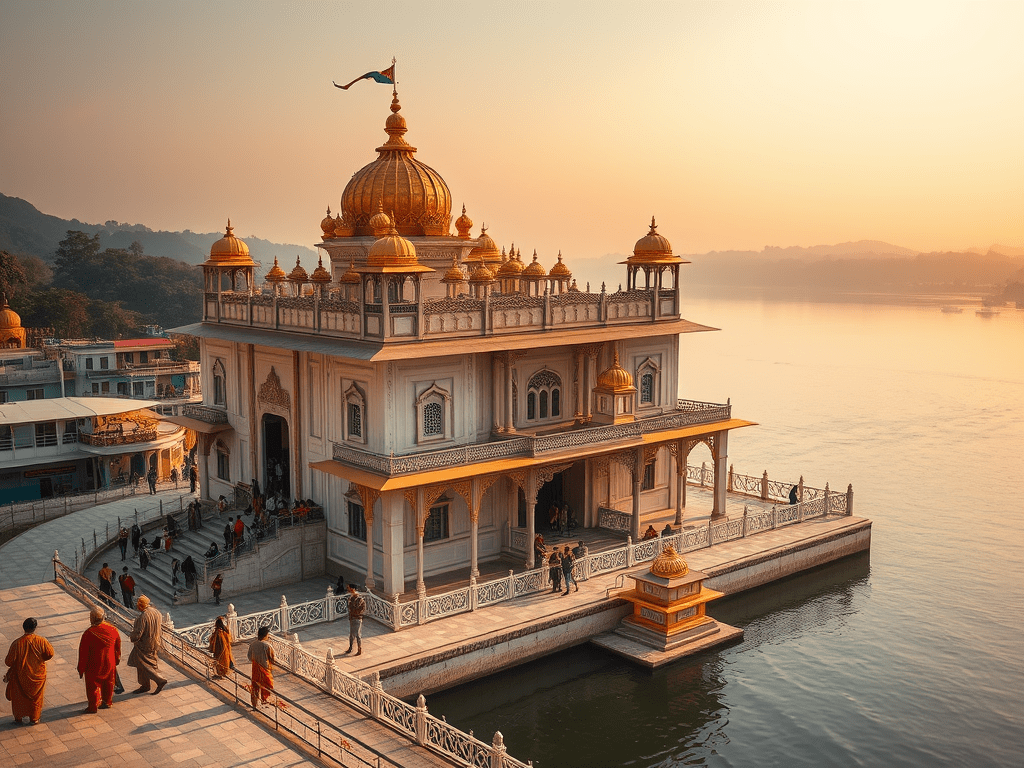
Gurudwara Sri Guru Tegh Bahadur Sahib is located in the strategic town of Dhubri. It is on the right bank of the Brahmaputra River in Assam, India. It symbolizes one of the most historically significant pilgrimage sites within the global Sikh tradition. It is also geographically remote. Known locally as Dumdume Gurdwara, the site’s sanctity stems from the travels of the first Sikh Guru. Guru Nanak Dev Ji visited around 1505 CE. It is also associated with the journey of the ninth Guru, Guru Tegh Bahadur Sahib Ji (circa 1670 CE).
Dhubri serves as the easternmost anchor point of the faith’s historical footprint in the subcontinent. It functions as a vital nexus where Punjabi heritage, spiritual universalism, and Assamese culture have converged. This convergence has occurred for over five centuries.
1.1 Thesis Statement
This report undertakes an in-depth analysis of Gurudwara Sri Guru Tegh Bahadur Sahib, Dhubri. It focuses on its dual historical foundation and its role as a site of peace mediation. The report highlights the unique cultural synthesis evident in the Axomiya Sikh diaspora. It also analyzes why it was strategically selected as the starting point. This selection was for the nationwide Nagar Kirtan commemorating the 350th martyrdom anniversary of Guru Tegh Bahadur.
The institutional recognition of this remote location highlights a crucial effort by the global Sikh community (Panth). They aim to integrate their diverse, non-Punjabi heritage into the central narrative of Sikh history and identity.
II. The Foundational History: Establishing Sikh Presence in the East
2.1 Guru Nanak Dev Ji’s Mission (1505 CE)
Encounter with Srimanta Sankardeva
The history of Dhubri Sahib begins in the 16th century with the travels (Udasis) of Guru Nanak Dev Ji. A defining spiritual and cultural moment happened during Guru Nanak’s visit to the region. He met Srimanta Sankardeva, the celebrated Assamese poet-saint. Srimanta Sankardeva was the founder of the Eka Sarana Nama Dharma movement.
Their meeting showed an early convergence between the universal monotheism of Sikhism and the devotional Bhakti tradition of Assam. This created a shared spiritual vocabulary that transcended ritualism.
Assertion of Spiritual Authority
Traditional accounts describe Assam, particularly the ancient region of Kamarupa, as a land associated with mystical practices and tantric lore. One narrative recounts that a local sorceress transformed Guru Nanak’s companion, Bhai Mardana, into a ram. The Guru restored him. He also guided the woman toward spiritual reform.
Such stories symbolized the Guru’s ability to overcome ignorance and superstition. They established Sikhism’s moral and spiritual authority in a land famed for its esoteric traditions.
2.2 Guru Tegh Bahadur’s Visit and Confirmation of the Site (1669–1670 CE)
The Geopolitical Context
More than a century later, Guru Tegh Bahadur visited Dhubri after departing from Dhaka in Bengal. His journey coincided with the Mughal campaign. Raja Ram Singh of Amber led the campaign. Emperor Aurangzeb sent him against the Ahom Kingdom of Assam.
Guru Tegh Bahadur’s presence served both spiritual and diplomatic purposes. He chose to accompany Raja Ram Singh. This decision aligned with his mission to revisit and sanctify the eastern region. This region was first blessed by Guru Nanak Dev Ji. Dhubri was transformed into a confirmed and enduring center of Sikh faith.
III. The Gurudwara as a Monument to Peace and Succession
3.1 Diplomacy and the End of Conflict
At Dhubri, Guru Tegh Bahadur acted as a mediator between the Mughal forces and the Ahom army. Both sides were wary. The Mughals feared the Assamese knowledge of terrain and mysticism. The Ahoms were cautious of Mughal might.
The Guru’s teachings of peace, restraint, and dialogue guided both armies toward reconciliation. The resulting treaty maintained pre-war boundaries, preventing bloodshed and marking a rare example of successful, faith-driven diplomacy in 17th-century India.
The Geopolitical Impact
This peaceful resolution elevated Guru Tegh Bahadur’s status beyond the spiritual realm. It portrayed him as a statesman whose moral authority transcended political boundaries. His intervention demonstrated that spiritual leadership could achieve what empires could not — lasting peace through understanding.
3.2 Damdama Sahib — The Mound of Peace
Guru Tegh Bahadur wanted to commemorate the resolution. He oversaw the creation of a large mound at the site where Guru Nanak had once rested. Soldiers from both the Mughal and Ahom armies each contributed five shieldfuls of earth. They transformed tools of war into instruments of service (Seva).
This symbolic act gave birth to Damdama Sahib — literally, “the Mound of Rest and Peace.” In 1966, a hut with an octagonal shape and sloping roof was constructed on the mound. It is now known as Thara Sahib. This hut was built to enshrine the Guru Granth Sahib. It preserves the sanctity of this monumental peace site.
3.3 Relics, Lore, and the Pivotal Narrative
The Gurudwara preserves powerful relics and local lore. One enduring legend tells of a massive 26-foot stone hurled by sorcerers toward the Guru. The stone landed harmlessly and remains embedded in the earth. It serves as a testament to faith’s triumph over hostility.
At Dhubri, Guru Tegh Bahadur received joyous news. His son, Gobind Rai, was born in Patna. Gobind Rai later became Guru Gobind Singh Ji. This moment directly connects Dhubri to the lineage that would culminate in the founding of the Khalsa.
IV. The Tangible Connection to Punjab: Artifacts and Administration
4.1 Preserved Historical Artifacts
Gurudwara Sri Guru Tegh Bahadur Sahib safeguards rare artifacts linking Assam to the Sikh heartland.
Among these is a preserved folio of the Mul Mantar. It is from an early Guru Granth Sahib manuscript and is believed to date from the 1660s. The sophistication of this artifact proves that learned Sikh communities existed in the far east during the Guru’s lifetime.
The Gurudwara also once held a Mughal Farman (imperial edict) granting land to the shrine. The document was tragically lost in the early 1900s. However, its existence affirms the site’s historical and legal recognition under Mughal rule.
4.2 Contemporary Administration and Service
The Gurudwara is managed by a dedicated local committee. Community members lead this group. They are committed to the principles of Seva (selfless service).
Daily prayers follow a full schedule. They begin with Asa Di Vaar at dawn. This is followed by the Hukamnama in the morning. Kirtan Sohila is held in the evening. The shrine offers Guru Ka Langar (community meal) continuously from 5:00 a.m. to 10:00 p.m., ensuring that all pilgrims, regardless of origin or faith, are served with equality and compassion.
Major annual events include Guru Tegh Bahadur Jayanti (April) and Shaheedi Gurpurab (November–December), drawing devotees from across India and abroad.
V. The Cultural Connection: The Axomiya Sikh Diaspora
5.1 The Military Diaspora of the 19th Century
A second wave of Sikh presence in Assam began in the 19th century. Maharaja Ranjit Singh sent 500 soldiers to aid the deposed Ahom king during the Burmese invasion. After the campaign failed, surviving soldiers settled in Assam, intermarried with local women, and founded the Axomiya Sikh community.
Their descendants, concentrated in Nagaon district and neighboring areas, continue to preserve Sikh identity while deeply rooted in Assamese society.
5.2 A Study in Assimilation
The Axomiya Sikhs embody a remarkable balance between religious fidelity and cultural adaptation.
- Language and Identity: Most speak Assamese, though they maintain unwavering devotion to Sikh principles.
- Dress and Tradition: Women often wear the Assamese Mekhla-Chador. They may carry a small Kirpan, blending local customs with Sikh symbols.
- Community Contribution: Many members have significantly enriched Assamese literature and culture. These include Nand Singh, a Sahitya Akademi Award-winning author.
5.3 Contemporary Dynamics
Today, Assam hosts two broad Sikh groups: the indigenous Axomiya Sikhs and newer Punjabi settlers. While relations are largely cordial, occasional cultural friction arises over language and tradition.
Recognizing Dhubri Sahib as the starting point of a national pilgrimage is a powerful affirmation. It confirms the authenticity of the Axomiya Sikhs. It highlights their contribution. This reaffirmation shows that Sikh identity transcends ethnicity and geography.
VI. The Sacred Passage: Nagar Kirtan from Dhubri Sahib to Anandpur Sahib
6.1 Context and Commemoration
The Shiromani Gurdwara Parbandhak Committee (SGPC) organized a nationwide Nagar Kirtan. This was to commemorate the 350th martyrdom anniversary of Guru Tegh Bahadur. It was a sacred procession that journeyed from Dhubri Sahib in Assam to Anandpur Sahib in Punjab.
The chosen theme was “Dharam Het Saaka Jini Keeya” (He who made supreme sacrifice for righteousness). It emphasized Guru Tegh Bahadur’s defense of freedom of faith.
The choice of Dhubri Sahib as the starting point symbolized the Guru’s journey from peace in the East. It also represented his martyrdom in the North. This created a powerful East–West spiritual axis across India.
6.2 The Journey and Route
The Nagar Kirtan traversed twenty states, uniting Sikh communities across India. Major halts included Siliguri, Kolkata, Patna Sahib, Varanasi, Mumbai, and finally, Anandpur Sahib.
Each stop connected diverse Sikh populations, transforming the event into both a spiritual and cultural bridge across regions.
6.3 The Culmination
The pilgrimage concluded at Sri Anandpur Sahib. Parallel processions from other sacred sites, such as Mattan Sahib (Jammu and Kashmir) and Sis Ganj Sahib (Delhi), converged here.
This convergence powerfully reaffirmed the unity of the Sikh Panth. It showcased the all-India reach of Guru Tegh Bahadur’s legacy. It highlighted the living connection between distant Sikh communities.
VII. Conclusion: Dhubri Sahib as an Enduring Axis of Sikh History
Gurudwara Sri Guru Tegh Bahadur Sahib, Dhubri, stands as a vital link in the spiritual and historical continuum of Sikhism.
It represents:
- Spiritual Foundation (16th Century): Guru Nanak Dev Ji’s visit established the site’s sanctity. His visit also created an early connection with Assamese devotional culture.
- Geopolitical and Theological Zenith (17th Century): Guru Tegh Bahadur’s mediation of peace helped create Damdama Sahib. This transformed the site into a monument of interfaith harmony.
- Cultural Diaspora (19th Century Onward): The Axomiya Sikh community was born from historical migrations. This community continues to uphold Sikh values. They do so within a distinct Assamese identity.
The SGPC’s decision to begin the 350th Martyrdom Anniversary Nagar Kirtan from Dhubri Sahib reaffirmed its historical and spiritual importance. This decision symbolizes the inclusivity of the Sikh faith.
Dhubri Sahib thus endures not merely as a monument of peace. It serves as a living bridge, connecting Punjab and Assam, faith and culture. It embodies the timeless message of the Gurus that transcends all boundaries.

Leave a comment