
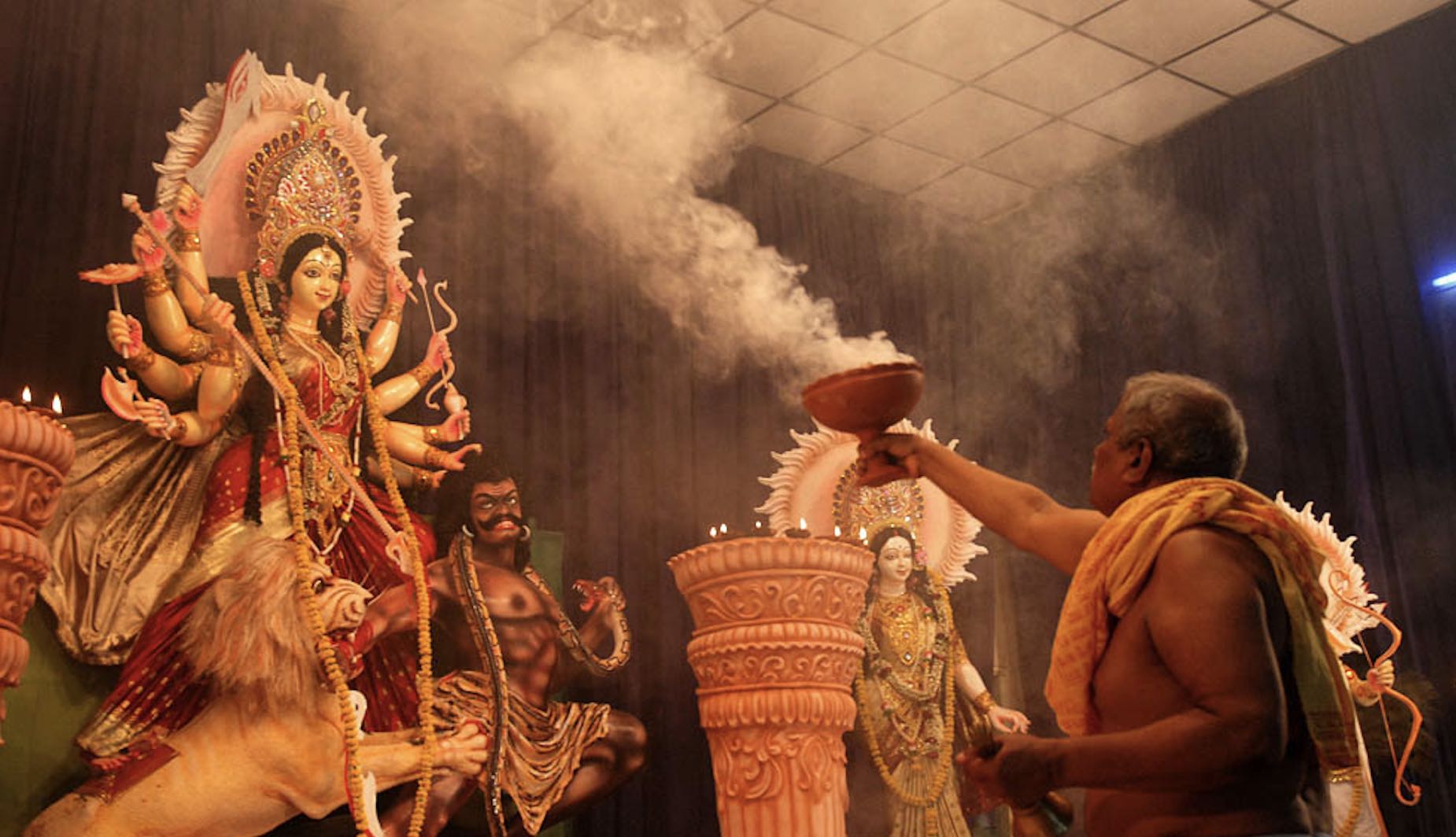
Durga Puja, also known as Durgotsava or Sharadotsava, is the foremost Hindu festival dedicated to the Goddess Durga. It symbolizes the cosmic triumph of good over evil (Dharma over Adharma).
While celebrated across India, it is profoundly dominant in cultural and socio-economic terms in the eastern states. These states are particularly West Bengal, Assam, Tripura, and Odisha.
This report offers a comprehensive analysis of the festival’s foundational theology. It delves into its intricate liturgical processes. It assesses its substantial economic impact. Additionally, it provides a comparative guide to the premier locations for witnessing its grand spectacle.
I. Foundation and Theological Context: The Durgotsava Paradigm
A. Historical and Mythological Origins: The Genesis of Mahishasuramardini
The festival commemorates the pivotal moment when Goddess Durga defeated the shape-shifting demon king Mahishasura.
Mahishasura, frequently depicted as a bovine asura (demon), represented the height of chaotic evil. He was deceptive and capable of changing his outer form. However, he never deviated from his demonic goals.
According to sacred texts, the demon had acquired a boon that made him invincible to all male deities.
To defeat him, the major male deities pooled their collective energies (Shakti) to manifest Durga.
Durga, the resultant Mahishasuramardini (“Slayer of Mahishasura”), is traditionally depicted astride a lion, piercing the heart of the buffalo-demon with her trishula (trident)
This act of divine warfare spans nine nights, known as Navaratri, with the victory finalized on the tenth day, Vijayadashami.
The mythological depiction conveys a profound spiritual symbolism. Mahishasura represents ignorance and chaos hidden beneath deceptive appearances. Durga’s serenity symbolizes the mastery of spiritual knowledge over ignorance.
B. Calendar, Chronology, and Cosmic Alignment
Durgotsava is traditionally observed during the Devi Paksha. This is a 15-day period within the Shukla Paksha (waxing moon) of the Hindu lunar month of Ashwin.
The Goddess is believed to descend to Earth on the first day of Devi Paksha. This follows Mahalaya Amavasya. She departs on the final day, which is Durga Visarjan.
The specific weekdays of her arrival and departure are considered omens for the coming year.
The festival encompasses five days of intense observation:
- Shashthi
- Maha Saptami
- Maha Ashtami
- Maha Navami
- Vijayadashami
While often synonymous with Navratri, the eastern observance emphasizes Durga’s victory and her symbolic homecoming.
Relationship with Vijayadashami and Dussehra
Vijayadashami coincides chronologically with Dussehra, which commemorates the defeat of Ravana by Rama.
The two share the same day but differ regionally in focus:
- Eastern India → Goddess Durga’s divine victory
- Northern & Western India → Lord Rama’s triumph
The autumnal worship of Durga (Sharadotsava) is an Akal Bodhon (untimely invocation). It is believed to have been initiated by Lord Rama before his battle with Ravana. This belief connects Durga Puja and Dussehra under the shared theme of righteous victory.
The Homecoming Motif
In Eastern India, Durga Puja also represents the homecoming of a daughter to her parents after defeating evil.
Thus, Vijayadashami becomes both a cosmic farewell and a familial goodbye, enriching the festival’s emotional and social depth.
II. The Liturgical Core: Rituals from Invocation to Farewell
A. Preparation and Sacred Materiality: Idol and Pandal
The pandal — an elaborately designed temporary structure — serves as the physical and artistic centerpiece of Durgotsava.
These range from simple community shelters to massive artistic installations, often themed around social messages or environmental causes.
The idol-making process begins months in advance. It often starts around Rath Yatra. Artisans, especially from Kumartuli, Kolkata, collect clay from the Ganges on Akshaya Tritiya.
A unique ritual involves adding punya mati (sacred soil) from nishiddho pallis (brothels) to the clay. This action symbolizes inclusion. It represents the goddess’s sanctification of all aspects of society.
The festival begins with Bodhon (awakening of the Goddess). Then, it continues with Chakshudaan (eye-painting ceremony). This marks the official start of Matribaksha (the reign of the Mother).
B. The Progression of Sacred Days
- Shashthi → Formal invocation (Kalparambha)
- Maha Saptami → Idol enlivening (Pran Pratisthan); bathing of the Kola Bou (plantain bride)
- Maha Ashtami →
- Kumari Puja (worship of a young girl as the living goddess)
- Sandhi Puja (performed at the Ashtami–Navami juncture; linked to Sun-Mars energies)
- Maha Navami → Concludes battle phase; includes Durga Balidan and Navami Homa
- Dashami (Vijayadashami) → Ritual farewell and victory celebration
C. Communal Culmination: Bhog and Visarjan
Bhog (community feast) includes:
- Khichuri (rice and lentils)
- Labra (mixed vegetables)
- Begun Bhaja (fried eggplant)
- Chutney and Payesh (rice pudding)
Sindoor Khela: Married women apply vermillion (sindoor) to the goddess and each other — symbolizing fertility and blessings.
Visarjan: Idols are immersed in rivers. This happens amid dhak drumming and Dhunuchi Naach (incense dance). This ceremony symbolizes Durga’s return to her celestial home.
III. Anthropological Perspectives and Societal Impact
A. The Economy of Devotion (The Puja Economy)
Durga Puja has evolved into a major economic engine, especially in West Bengal.
The festival’s creative industries were valued at ₹32,377 crores (pre-pandemic data).
Key sectors impacted:
- Retail & Apparel – peak consumer spending period
- Artisans – employment for idol makers and decorators
- Hospitality & Tourism – millions of visitors annually
- Temporary Labor – pandal setup, security, catering, events
In 2021, UNESCO inscribed Kolkata’s Durga Puja on its Representative List of the Intangible Cultural Heritage of Humanity. This recognition highlights its artistic vitality and socio-economic impact.
B. The Cultural Counter-Narrative: Mahishasura as Ancestor
Certain tribal groups hold a unique perspective on Mahishasura. The Asur, Kherwal Santal, and Kolarian Dravidian communities revere him as a benevolent ancestor rather than a demon.
During Durga Puja, they mourn instead of celebrate, performing the Dasai dance to honor their fallen king.
This counter-narrative exposes historical and cultural tensions, reflecting ancient conflicts between Aryan and indigenous identities.
For them, Durga’s victory represents colonial conquest, not cosmic justice — an essential reminder of India’s plural cultural memory.
IV. Experiential Analysis: Focused Guide to the Best Places for Durgotsava
A. The Global Epicenter: Kolkata, West Bengal
Kolkata is the beating heart of Durga Puja — a living museum of art, devotion, and community.
- Artistry: Massive themed Sarbojonin pandals with creative, competitive designs.
- Heritage: Bonedi Bari pujas (ancestral homes) preserve centuries-old rituals.
- Climax: Grand Visarjan into the Hooghly River.
B. Diaspora Hubs: Delhi and Mumbai
Delhi (Chittaranjan Park) – Known as Mini Kolkata, hosting authentic Bengali-style pandals, Dhunuchi dances, and bhog feasts.
Mumbai – Home to the Bombay Durgabari Samiti (BDBS), established in 1930, maintaining community traditions through devotional unity and food.
C. Distinct Regional Eastern Flavors: Odisha and Assam
Odisha (Bhubaneswar) – Focus on idol opulence rather than pandals; Durga idols are decorated with gold and silver filigree work.
Assam (Guwahati) – Retains Bengal-style fervor but infused with local Assamese customs and Shakta traditions.
D. Western Integration: The Fusion Experience (Ahmedabad, Gujarat)
In Gujarat, Durga Puja fuses with Navratri — emphasizing Garba and Dandiya Raas over idol worship.
While rooted in Shakti devotion, it celebrates divine energy through music, rhythm, and dance.
Comparative Table: Premier Durgotsava Destinations
| Destination | Primary Focus/Atmosphere | Artistic/Ritual Highlight | Key Differentiator | Recommended for |
|---|---|---|---|---|
| Kolkata, West Bengal | Community Carnival & Public Art | Thematic Pandals, UNESCO Heritage | Scale, creativity, tradition | Deep immersion in artistry & rituals |
| Delhi (CR Park) | Diaspora Community & Tradition | Dhunuchi Naach, Bhog | Authentic “Mini Kolkata” experience | Accessible experience outside Bengal |
| Bhubaneswar, Odisha | Temple/Deity Veneration | Gold/Silver Filigree Idols | Focus on ornamentation | Craftsmanship & heritage lovers |
| Ahmedabad, Gujarat | Navratri Festival Syncretism | Garba & Dandiya Raas | Dance-based communal celebration | Festival through music & movement |
V. Conclusion and Recommendations for the Cultural Traveler
A. Synthesis: Durgotsava in the Modern Indian Context
Durgotsava embodies both spiritual transcendence and socio-economic vitality.
It celebrates the divine feminine’s victory over darkness while fueling innovation, employment, and tourism.
Its UNESCO recognition confirms its global cultural stature.
The festival’s dual symbolism — Durga as Protector and Durga as Daughter — makes sure it remains both sacred and emotional. It is timeless and adaptive.
B. Practical Recommendations for Optimal Experience
Ideal Timing:
Arrive one week before the main Puja (to witness Mahalaya and Chakshudaan) and stay through Dashami (Visarjan).
Destination Strategy:
- For Artistic Immersion: Kolkata – balance modern Sarbojonin with Bonedi Bari heritage pujas.
- For Ritual Purity: Focus on Maha Ashtami’s Sandhi Puja and Kumari Puja (Kolkata & Delhi).
- For Regional Craftsmanship: Bhubaneswar – admire filigree idols and Odissi traditions.
- For Participatory Energy: Ahmedabad – join Garba and Dandiya for a vibrant Shakti celebration.
🔗 References & Further Reading
- UNESCO: Durga Puja in Kolkata – Intangible Cultural Heritage Listing (2021)
- Devi Mahatmya – Markandeya Purana, Chapters 81–93
- “Hudur Durga: The Asur Narrative.” Down To Earth, 2021
- Banglapedia: Durga Puja
- The Hindu – “The Rituals of Durga Puja Explained”
- Economic Times – “Puja Economy worth ₹32,000 crore in Bengal”
- Times of India – “Navratri vs Durga Puja: The Great Indian Festive Contrast”
- Kumartuli Artisans and Pandal Culture, Kolkata Tourism Board Report, 2023
- Cultural Anthropology Journal – “Sacred Clay and Social Inclusion in Bengal’s Idol-Making” (2019)
Leave a Reply