




📜 Abstract
This research paper examines the deep cultural importance of the Punjabi Chooda ceremony. It is a pre-wedding ritual that symbolizes a bride’s transition into married life. We will first dissect the ceremony’s components, symbolism, and socio-familial importance. Subsequently, we will conduct a comparative global analysis. We will identify traditions from various cultures that echo the core themes of the Chooda ceremony. These themes include the bestowal of blessings through adornment. They also emphasize the significant role of maternal relatives. There is the symbolic transition of status and rituals for prosperity and protection. Through this comparative lens, we will demonstrate that the artifacts and practices are unique. However, the underlying human sentiments and intentions are remarkably universal.
✨ Part 1: A Detailed Anatomy of the Punjabi Chooda Ceremony
The Chooda Vadhai Rasam (more accurately, the ceremony is called Chooda Chadana – “to put on the bangles.” Vadhai means congratulations.) This ceremony is a cornerstone of a traditional Punjabi wedding. It is primarily practiced by Sikh and Hindu communities originating from the Punjab region. It is far more than just putting on bangles; it is a tapestry of blessings, emotions, and deep-rooted symbolism.
1.1 The Artifact: The Chooda
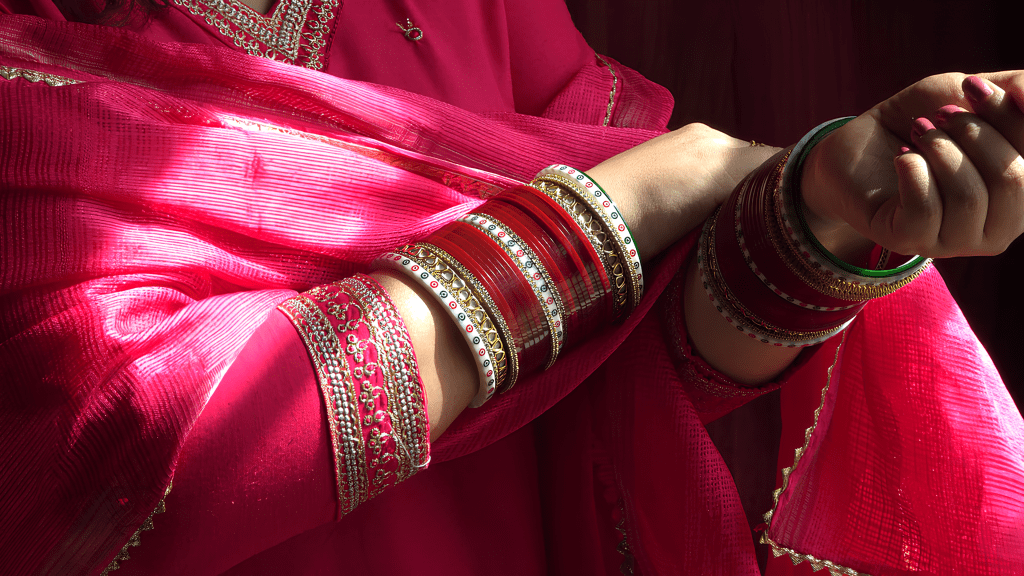
- Composition: The Chooda is a set of bangles, traditionally numbering 21 on each arm, although modern variations exist.
- Color Symbolism: The set is a combination of red (or maroon) and white (or ivory/cream) bangles.
- Red/Maroon: This color is universally symbolic of auspiciousness, love, passion, and, crucially, fertility (Suhag). It signifies the bride’s new status as a married woman.
- White/Ivory: This represents purity, peace, and the beginning of a new life with her husband’s family. The ivory was traditionally used, signifying wealth and status.
- Quantity: The number 21 is considered auspicious in many Indian traditions. The bangles are often of varying thickness, arranged in a specific pattern.
1.2 The Ceremony: The Chooda Chadana Rasam
This ceremony typically takes place on the morning of the wedding day at the bride’s home.
- The Purification: The set of bangles is first purified in a ritualistic manner. It is dipped into a vessel containing kacchi lassi (a mixture of raw milk and water) and rose petals. This act sanctifies the bangles, cleansing them of any negativity before they are worn by the bride.
- The Havan/Puja: A small religious ceremony (havan or puja) is conducted by a priest. The bride, along with her parents and maternal uncle (mama) and aunt (mami), participates. Prayers are offered for the bride’s happy and prosperous married life.
- The Key Participants: The Maternal Uncle (Mama) and Aunt (Mami) This is the most critical element. The Chooda is a gift from the bride’s maternal family. Her mama has the primary honor of placing the bangles on her wrists. Its significance is profound: this act signifies the maternal family’s final blessing and their role in her upbringing. The mama acts as a representative of her mother’s entire lineage. He bestows their collective love and goodwill upon her as she departs her natal home.
- The Blinding & Covering: The bride’s eyes are closed as the bangles are put on. This wards off the “evil eye” (nazar). Immediately after, they are covered with a white cloth. The bride only sees her Chooda for the first time with her full bridal attire. This builds anticipation. It also protects the sacred blessings.
1.3 The Kalire Ceremony
Following the Chooda ceremony, the bride’s sisters and friends tie Kalire to her bangles.
- What are they? Kalire are umbrella-shaped metallic ornaments, often gold or silver-plated, symbolizing prosperity and good wishes for the bride’s new home.
- The Ritual: The bride shakes her hands over the heads of her unmarried friends. People think that if a piece of the Kalire falls on one of them, she will be the next to marry. This belief adds a playful element to the day.
1.4 Post-Wedding Significance
- Duration: A bride traditionally wears her Chooda for a minimum of 40 days (sava mahina) and up to a year.
- Symbol of Status: The Chooda is an immediate visual signifier of a newly married woman. It affords her special status and respect.
🌍 Part 2: A Global Comparative Analysis
While the Chooda is uniquely Punjabi, its core themes are universal.
Theme 1: Symbolic Adornment as a Marker of Marital Transition
- The Western Wedding Ring (Global):
- Comparison: The ultimate parallel, the ring’s circular shape symbolizes eternity. It’s a powerful, non-verbal communicator of marital status.
- Contrast: The ring is a permanent adornment. It is exchanged between the couple. The Chooda is temporary. It is a gift from the maternal family.
- Chinese Dragon and Phoenix Bangles (Long Feng Gua) (China):
- Comparison: Elders gift these gold bangles during the tea ceremony. They feature dragon (male) and phoenix (female) engravings. These symbols represent marital harmony and good fortune.
- Contrast: These are treasured as heirlooms, whereas the Chooda is worn for a set period post-wedding.
- The Berber Fibula (North Africa):
- Comparison: Ornate silver brooches (fibulae) signify a Berber bride’s tribal identity and new marital status. Their intricate designs often contain symbols to ward off the evil eye, a direct parallel to covering the Chooda.
Theme 2: The Role of Family in Bestowing Blessings
- The Greek “Krevati” (Bed-Making Ceremony) (Greece):
- Comparison: Relatives make the couple’s new bed. They throw money and rice for prosperity. A baby is rolled on it to bless the union with fertility. This collective familial act directly matches the purpose of the Chooda and Kalire.
- The Jewish Henna Ceremony (Sephardic & Mizrahi communities):
- Comparison: A matriarch applies henna to the bride’s palm, often with a gold coin for prosperity. Elder women lead the ceremony. It honors the family’s role in blessing the bride. This is similar to the Chooda ceremony’s focus on the maternal uncle.
- The Maasai Wedding Collar (Enkarewa) (Kenya/Tanzania):
- Comparison: A mother gifts her daughter an elaborate wedding collar, representing her lineage, love, and blessings. This gifting of a symbolic adornment by a key maternal figure is a powerful parallel.
Theme 3: Rituals of Protection and Transition
- “Something Old, New, Borrowed, Blue” (Western):
- Comparison: This Victorian-era rhyme is a recipe for good luck. “Something blue” specifically was meant to ward off the Evil Eye, mirroring the protective aspect of veiling the Chooda.
- The Turkish Henna Night (Kına Gecesi) (Turkey):
- Comparison: A deeply emotional ceremony marking the bride’s departure. Sad songs are followed by joyful ones. This beautifully encapsulates the bittersweet nature of the transition. This emotion is palpable during the Chooda ceremony.
- The Filipino Cord and Veil Ceremony (Philippines):
- Comparison: During the wedding, sponsors drape a veil and a knotted cord over the couple. This act signifies they are bound and “clothed as one.” It’s a blessing for an inseparable union, bestowed by respected family figures.
📊 Part 3: Synthesized Comparison Table
| Tradition | Primary Symbol/Artifact | Key Participants | Core Meanings & Parallels |
| Punjabi Chooda | Red & White Bangles, Kalire | Maternal Uncle (Mama) & Aunt (Mami) | Fertility, Prosperity, Marital Status, Protection, Maternal Blessings |
| Western Wedding Ring | Gold/Platinum Ring | The Couple | Eternal Bond, Fidelity, Marital Status |
| Chinese Long Feng Gua | Gold Dragon & Phoenix Bangles | Groom’s Parents/Elders | Harmony, Good Fortune, Prosperity, Blessings from In-laws |
| Greek Krevati | The Marital Bed, Money, a Baby | Female Relatives & Friends | Fertility, Prosperity, Community Blessing |
| Jewish Henna | Henna Paste, Gold Coin | Matriarchs (Mother/Grandmother) | Joy, Protection from Evil Eye, Prosperity, Familial Blessing |
| Maasai Enkarewa | Wedding Collar | Mother of the Bride | Maternal Blessing, Lineage, Protection, Marital Status |
| Turkish Kına Gecesi | Henna | Female Relatives & Friends | Protection, Emotional Transition, Blessing for the New Home |
| Filipino Cord & Veil | Ceremonial Cord & Veil | Sponsors/Godparents | Inseparable Union, “Becoming One,” Blessing from Elders |
Export to Sheets
🌟 Conclusion
The Chooda Chadana Rasam is a rich, multi-layered Punjabi tradition. It beautifully articulates the hopes, blessings, and anxieties associated with marriage. The sight of the red and white bangles is culturally specific. However, its foundational themes are woven into the very fabric of human matrimonial rites across the globe.
A gold ring in the West, a Dragon and Phoenix bangle in China, or a henna-stained hand in Turkey. These adornments speak the universal language of bridal adornment. It speaks of a change in identity, a blessing for prosperity, and a protective shield offered by family. The Chooda ceremony is a vibrant Punjabi expression of a universal human impulse. It marks a life-altering transition with love and ritual. It also carries a profound hope for the future.

Leave a comment