
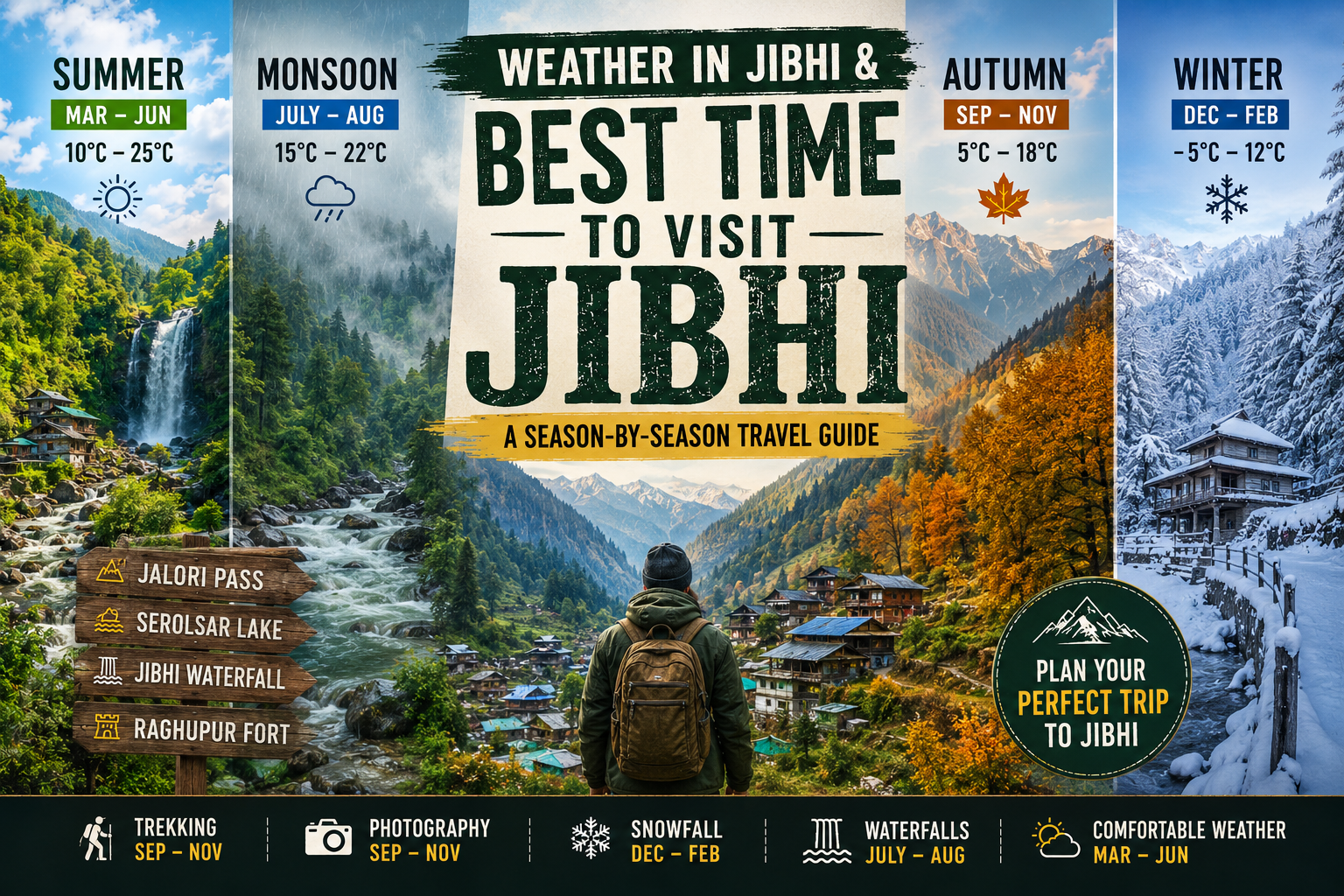
Jibhi is beautiful throughout the year.
But the experience changes dramatically with each season.
In summer, the valley bursts into shades of green.
During monsoon, waterfalls roar with unmatched force.
Autumn paints the mountains under crystal-clear skies.
And winter transforms the entire region into a snow-covered paradise.
Choosing the right time to visit depends entirely on what kind of experience you’re looking for.
Whether it’s trekking, snowfall, photography, or simply escaping city life, Jibhi offers something unique in every season.
Jibhi Climate Overview
Jibhi experiences a temperate Himalayan climate.
Because the village sits at an elevation of around 2,242 meters (7,356 feet), temperatures remain pleasant during summer and can drop well below freezing during winter.
The surrounding mountains also create:
- Localized wind systems
- Persistent moisture
- Cool river breezes
- Frequent fog during monsoon
- Heavy snowfall in higher regions
One fascinating aspect of Jibhi’s geography is that the area surrounding the waterfall remains significantly cooler throughout the year due to the constant mist and humidity.

Jibhi Weather at a Glance
| Season | Months | Temperature | Travel Recommendation |
|---|---|---|---|
| Summer | March – June | 10°C to 25°C | ⭐⭐⭐⭐⭐ Best Time |
| Monsoon | July – August | 15°C to 22°C | ⭐⭐ Avoid if possible |
| Autumn | September – November | 5°C to 18°C | ⭐⭐⭐⭐⭐ Excellent |
| Winter | December – February | -5°C to 12°C | ⭐⭐⭐⭐ Snow Lovers |
Summer in Jibhi (March to June)
Temperature:
10°C to 25°C
Summer is undoubtedly the most popular season in Jibhi.
As snow melts in the higher mountains, rivers swell with fresh glacial water and forests come alive.
Days are:
- Sunny
- Pleasant
- Comfortable for sightseeing
Nights remain:
- Cool
- Crisp
- Perfect for bonfires
This is the season when:
✔ Jibhi Waterfall flows beautifully
✔ Cafes operate at full capacity
✔ Trekking routes are open
✔ Treehouses are in high demand
✔ Jalori Pass remains accessible
Why Summer Is the Best Time to Visit Jibhi
If it’s your first visit, summer is ideal.
You can comfortably explore:
- Jibhi Waterfall
- Mini Thailand
- Jalori Pass
- Serolsar Lake
- Raghupur Fort
- Tirthan Valley
- Chaini Kothi
The weather is stable, road conditions are good, and the valley is covered in lush greenery.
Summer Packing List
Carry:
✅ Light jackets
✅ Trekking shoes
✅ Sunglasses
✅ Sunscreen
✅ Reusable water bottles
✅ Light woolens for evenings
Monsoon in Jibhi (July to August)
Temperature:
15°C to 22°C
Monsoon changes the mood of Jibhi completely.
The forests become darker.
Clouds descend into the valleys.
Streams appear from nowhere.
And the waterfalls roar with incredible force.
Visually, this is one of the most beautiful times to visit.
But it also comes with significant risks.
Is It Safe to Visit Jibhi During Monsoon?
The short answer:
Usually, no.
Heavy rainfall often causes:
- Landslides
- Falling rocks
- Road blockages
- Flash floods
- Slippery trekking trails
The mountain roads around:
- Aut
- Banjar
- Jalori Pass
- Shoja
can become dangerous after prolonged rainfall.
Why Landslides Are Common
The mountains surrounding Jibhi consist of:
- Clay
- Shale
- Loose sedimentary rock
When exposed to heavy rainfall, these slopes become unstable.
Entire sections of road can be blocked temporarily.
Travelers should constantly monitor:
- Weather forecasts
- Local advisories
- Road conditions
before planning a monsoon trip.
Is Monsoon Ever Worth It?
Surprisingly, yes.
If:
- You enjoy misty weather
- Love photography
- Prefer fewer crowds
- Are comfortable with uncertain travel plans
Monsoon can feel magical.
The forests become incredibly vibrant.
Waterfalls are at their most powerful.
And the valley looks like something straight out of a fantasy movie.
Autumn in Jibhi (September to November)
Temperature:
5°C to 18°C
If summer is the most popular season,
then autumn is the most underrated.
Many experienced travelers consider autumn the absolute best time to visit Jibhi.
Why?
Because the weather becomes:
- Dry
- Sunny
- Stable
- Crystal clear
Visibility improves dramatically.
The skies turn deep blue.
And distant Himalayan ranges become visible for miles.
Best Season for Trekking
Autumn is perfect for exploring:
Jalori Pass
The iconic mountain pass offers:
- Spectacular valley views
- Dense pine forests
- Scenic drives
- Sunrise photography
Serolsar Lake Trek
This trek becomes especially beautiful during autumn.
Expect:
- Golden forests
- Crisp mountain air
- Mirror-like lake reflections
- Comfortable temperatures
Raghupur Fort Trek
Autumn provides ideal conditions for hiking to:
- Ancient fort ruins
- Open meadows
- Panoramic Himalayan viewpoints
Why Photographers Love Autumn
The atmosphere becomes exceptionally clear.
This means:
✔ Better mountain visibility
✔ Richer sunrise colors
✔ Stunning sunsets
✔ Perfect stargazing
✔ Sharper landscape photography
Winter in Jibhi (December to February)
Temperature:
-5°C to 12°C
Winter transforms Jibhi into an entirely different world.
Snow blankets rooftops.
The forests become silent.
Streams partially freeze.
And thick fog rolls through the valley.
It is peaceful.
Mysterious.
And unbelievably beautiful.
Does It Snow in Jibhi?
Yes.
Jibhi receives snowfall almost every winter.
However, snowfall intensity varies.
The higher regions receive significantly more snow.
Popular snowfall spots include:
- Jalori Pass
- Shoja
- Serolsar Lake route
- Bahu village
- Tandi village
Even when Jibhi village itself receives light snowfall, the surrounding mountains usually remain covered in snow.
Jibhi Waterfall in Winter
One of the most magical sights in winter is the waterfall itself.
As temperatures drop:
- Water flow decreases
- Ice begins forming around rocks
- Frost covers surrounding vegetation
- Mist freezes along the edges
The result is a stunning semi-frozen waterfall that looks straight out of a fairy tale.
Jalori Pass Winter Closure
Travelers planning a winter trip should pay special attention to:
Jalori Pass Road Status
Due to:
- Heavy snowfall
- Thick ice sheets
- Dangerous driving conditions
Jalori Pass often closes between:
November to March
In some years, it remains inaccessible until April.
Always check:
- Local weather reports
- Hotel updates
- Taxi operators
before planning the route.
Winter Packing Guide
Winter in Jibhi can be harsh.
Essential items include:
Clothing
✔ Thermal innerwear
✔ Heavy wool sweaters
✔ Fleece jackets
✔ Down jackets
✔ Waterproof gloves
✔ Woolen caps
Footwear
Carry:
✔ Waterproof trekking shoes
✔ High-grip soles
✔ Wool socks
Avoid:
❌ Sneakers with smooth soles
❌ Open footwear
❌ Canvas shoes
Snow and ice can make trails extremely slippery.
Which Season Is Best for You?
| If You Want… | Best Season |
|---|---|
| Sightseeing | March – June |
| Trekking | September – November |
| Snowfall | December – February |
| Photography | September – November |
| Green Landscapes | July – August |
| Waterfalls at Full Flow | Monsoon |
| Comfortable Weather | Summer |
| Honeymoon | Winter or Autumn |
Best Time to Visit Jibhi: Final Verdict
If you’re visiting Jibhi for the first time,
Choose:
March to June
or
September to November
These months offer:
✔ Pleasant weather
✔ Open trekking routes
✔ Beautiful scenery
✔ Safer road conditions
✔ Excellent photography opportunities
If you dream of:
- Snow-covered cabins
- Warm cafes
- Bonfires under the stars
- Quiet mountain mornings
Then winter will steal your heart.
And if you crave:
- Misty forests
- Powerful waterfalls
- Moody landscapes
Monsoon can be magical—provided you’re prepared for its unpredictability.
No matter when you visit, one thing remains constant:
Jibhi has a way of slowing life down.
And in today’s fast-moving world,
that might just be its greatest gift.
Coming Up in Part 5
- How to Reach Jibhi from Delhi
- Chandigarh to Jibhi Road Trip
- The Important Aut Tunnel Diversion
- Bus Routes & Volvo Services
- Taxi Prices
- Nearest Railway Station
- Bhuntar Airport Guide
- Self Drive Tips & Road Conditions
Leave a Reply