
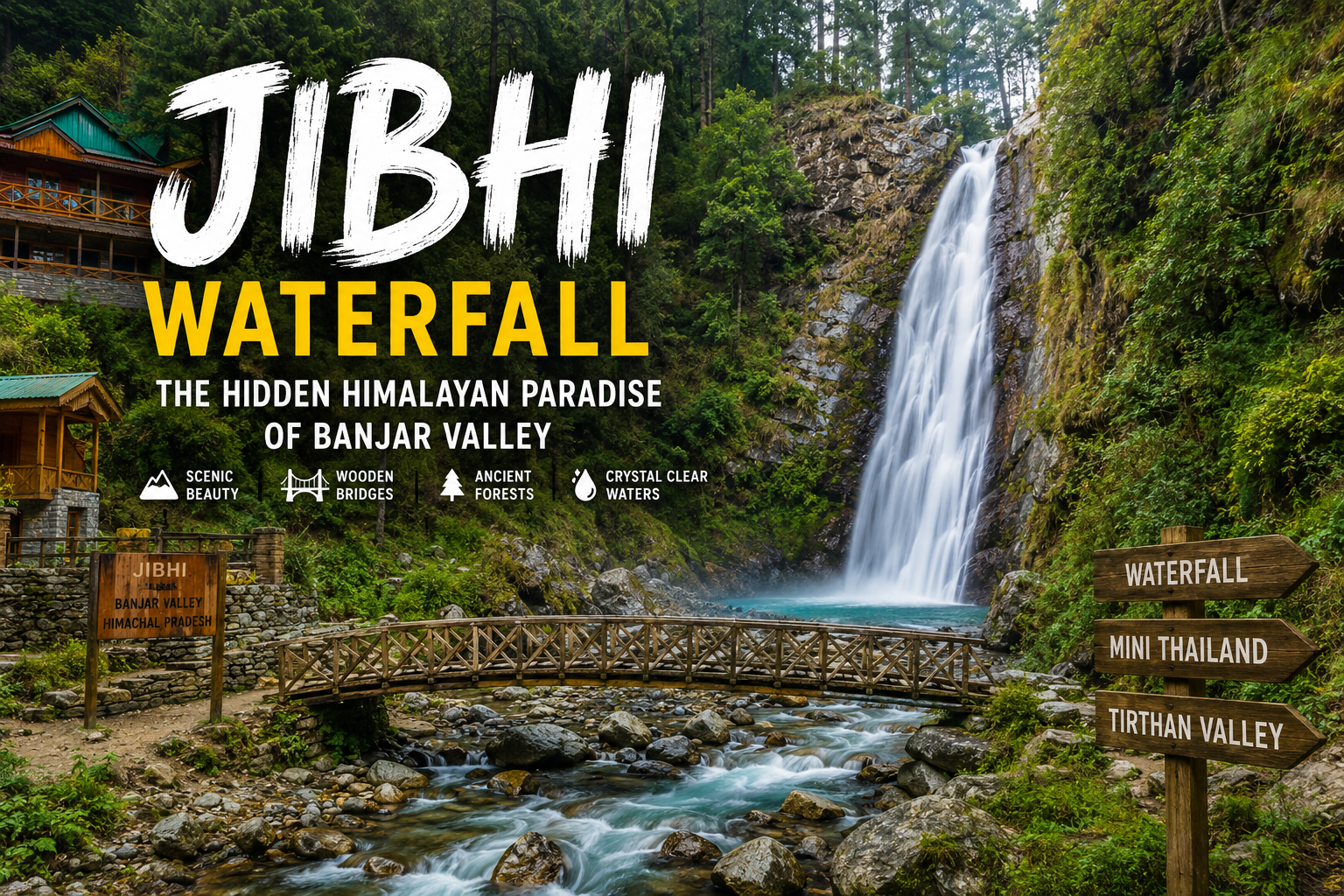
Ancient forests, sacred rivers, wooden bridges, and a waterfall hidden deep inside the Himalayas — Jibhi is not just a destination; it’s an experience woven with nature, mythology, and centuries of mountain heritage.
Quick Facts About Jibhi Waterfall
| Feature | Details |
|---|---|
| Location | Jibhi Village, Banjar Valley, Kullu District, Himachal Pradesh |
| Elevation | 2,242 meters (7,356 ft) |
| Waterfall Height | 55 feet (16.7 meters) |
| River Basin | Tirthan River Basin |
| Famous For | Waterfall, Wooden Bridges, Mini Thailand, Treehouses |
| Nearest Airport | Bhuntar Airport |
| Best Time to Visit | March to June & September to November |
| Entry Fee | INR 20 |
| Timings | 9 AM – 6 PM |
Introduction: Why Jibhi Waterfall Captures Every Traveler’s Heart
Nestled deep within the Banjar Valley of Himachal Pradesh, Jibhi Waterfall is one of those rare places that still feels untouched by the chaos of mass tourism.
Hidden beneath towering deodar trees and surrounded by moss-covered rocks, the waterfall emerges suddenly from dense Himalayan forests, cascading gracefully from a height of nearly 55 feet into a serene stone basin below.
The sound of rushing water echoes through the valley, mixing with birdsong and the gentle rustling of ancient cedar trees.
Unlike many popular hill stations that have become overcrowded, Jibhi retains its old-world charm.
Wooden cottages cling to mountain slopes.
Traditional Kath-Kuni homes stand proudly beside modern treehouses.
Narrow pathways cross crystal-clear streams using rustic wooden bridges.
And everywhere you look, the mountains seem to whisper stories from centuries ago.
But Jibhi is much more than a pretty waterfall.
It is a land shaped by glaciers, ancient trade routes, sacred lakes, serpent goddesses, and festivals where masked dancers enter spiritual trances.
This unique blend of nature and culture has transformed Jibhi into one of the most fascinating destinations in the Western Himalayas.
Where is Jibhi Waterfall Located?
Jibhi is located in the picturesque Banjar Valley of Kullu district in Himachal Pradesh.
Situated at an elevation of approximately 2,242 meters above sea level, the village lies within the outer ranges of the Western Himalayas.
The landscape here is dramatic.
Deep valleys slice through the mountains.
Steep ridges rise into the clouds.
Dense forests of deodar cedar, blue pine, and Himalayan oak blanket the slopes.
The region enjoys cool weather throughout the year, and the surrounding mountains create a perfect environment for rivers, streams, and waterfalls to flourish.
The Tirthan River: The Lifeline of Banjar Valley
At the heart of this ecosystem flows the mighty Tirthan River.
Originating from glacial lakes deep inside the Great Himalayan National Park, the river winds through valleys and forests before joining the Sainj River and eventually merging with the Beas River near Larji.
What makes the Tirthan River truly unique is that it remains completely free from hydroelectric dam projects.
This is an extraordinary achievement in Himachal Pradesh, where many rivers have been altered by dams.
Because of this untouched status, the river continues to support:
- Native Himalayan trout
- Traditional terrace farming
- Drinking water for local communities
- Rich riverine biodiversity
- Sensitive wildlife habitats
Its crystal-clear waters are among the cleanest in the state and form the ecological backbone of the entire Banjar Valley.
The Geography Behind Jibhi Waterfall
The Jibhi Waterfall is part of a small but ecologically significant mountain watershed located near the Tandi and Rashala regions.
The waterfall plunges through layers of moss-covered rock and thick vegetation before collecting in a natural pool below.
For generations, this waterfall served as:
- A primary water source
- A meeting point for villagers
- A sacred site for rituals
- A resting point for travelers
The constant spray from the waterfall creates a cool and humid microclimate around it.
This moisture supports a thriving ecosystem of:
- Ferns
- Mosses
- Bryophytes
- Rare mountain plants
- Moisture-loving insects
Even during summer, the area around the waterfall remains noticeably cooler than the rest of the valley.
From Hidden Forest Trail to Tourist Attraction
Years ago, reaching Jibhi Waterfall wasn’t easy.
Visitors had to navigate rough forest tracks used primarily by local villagers.
As tourism slowly increased, local communities chose a different path from commercial development.
Instead of concrete walkways and massive construction, villagers built:
- Rustic wooden bridges
- Stone-paved pathways
- Small resting areas
- Traditional wooden railings
The goal was simple:
Make the waterfall accessible without destroying its natural beauty.
Today, the path to the waterfall feels like a fairy tale.
Tiny streams run beneath wooden bridges.
Wildflowers bloom beside the trails.
The smell of wet earth fills the air.
And as the roar of the waterfall grows louder, anticipation builds with every step.
Human Intervention and Conservation
Although Jibhi Waterfall remains largely natural, some modifications have been introduced for safety and erosion control.
The pool beneath the waterfall has been partially paved using stone and cement.
This helps:
- Prevent soil erosion
- Control excessive sediment buildup
- Improve visitor safety
- Create a stable basin for seasonal tourism
The result is an interesting balance.
Nature remains the main attraction, while thoughtful engineering helps preserve the site for future generations.
It is a living example of how ecotourism and environmental conservation can coexist.
Nearby Attractions Around Jibhi Waterfall
Jibhi is surrounded by some of the most beautiful hidden spots in Himachal Pradesh.
Mini Thailand
Just 1–2 kilometers from the waterfall lies a fascinating geological formation locals call Mini Thailand.
Massive limestone boulders tower above turquoise mountain waters, creating a scenic canyon that surprisingly resembles tropical Southeast Asian landscapes.
The place has become famous for:
- Natural swimming pools
- Crystal-clear water
- Photography
- Short hikes
- Riverside relaxation
Chhoie Waterfall
Located near Sharchi village, Chhoie Waterfall is another hidden gem of the Tirthan Valley.
Unlike Jibhi Waterfall, Chhoie remains more secluded and is deeply connected with local conservation initiatives.
It is popular among:
- Nature photographers
- Trekkers
- Bird watchers
- Adventure seekers
Serolsar Lake
High above the valley, beyond Jalori Pass, lies the mystical Serolsar Lake.
Surrounded by oak and kharsu forests, the lake is famous for:
- Mirror-like reflections
- Sacred legends
- Dense forests
- High-altitude trekking
- Budhi Nagin Temple
For locals, however, Serolsar is far more than a scenic lake.
It is considered one of the holiest water bodies in the region.
And its legends are as fascinating as its beauty.
Why Jibhi Feels Different
There are many beautiful places in Himachal Pradesh.
But very few places combine:
✔ Ancient architecture
✔ Sacred traditions
✔ Glacier-fed rivers
✔ Dense Himalayan forests
✔ Hidden waterfalls
✔ Authentic village life
✔ Sustainable tourism
Jibhi isn’t trying to become the next Manali.
And perhaps that’s exactly why people fall in love with it.
The village still moves slowly.
The forests still dominate the landscape.
And the waterfall continues to sing the same song it has sung for centuries.
Coming Up in Part 2
- Ancient History of Jibhi
- The Kullu Kingdom and Tibetan Trade Routes
- The incredible Kath-Kuni Architecture
- Chaini Kothi: 1,500-Year-Old Himalayan Tower
- Raghupur Fort and forgotten mountain wars
Leave a Reply