
Introduction
Faith, Soil, and the Hydrology of Flavor
The culinary topography of Amritsar is not merely a collection of historic recipes; it is a living archive of theological development, regional geography, and structural economic shifts.
Located in Punjab—historically defined by its five major river basins—the city of Amritsar represents a unique ecological corridor where glacial hydrology meets rich alluvial soil. The cold, sweet freshwater runoff of the Beas, Ravi, and Sutlej rivers has historically dictated not only the local fish species available but also the soft, gluten-light protein structures of the regional wheat.
Amritsar’s culinary evolution is fundamentally anchored to:
- The development of Sikhism
- Mughal imperial kitchens
- The trauma of the 1947 Partition
- Commercialization of farm-style Punjabi comfort food
From the massive community kitchens of the Golden Temple to the slow-cooked vegetarian dhabas hidden inside the narrow alleys of the old walled city, Amritsar operates on a systemic philosophy of:
- Generous hospitality
- Culinary hyper-specialization
- Resistance to industrial shortcuts
This report examines the historical, sociological, and geographical foundations of Amritsar’s food culture.
The Spiritual Engine of Equality
Guru Ka Langar and Communal Scale
At the center of Amritsari identity is Guru Ka Langar, the free community kitchen operating continuously within the Golden Temple complex.
Originally conceived as a revolutionary intervention against caste hierarchy and socio-economic segregation, langar represents the socialization of dining.
Socio-Historical Evolution and Theology
The theological foundation of langar was established in the late 1400s by Guru Nanak Dev Ji in Kartarpur.
The principles included:
- Equality in dining
- Shared floor seating (Pangat)
- Vegetarian meals for universal inclusion
- Volunteer-based cooking and serving
Guru Amar Das Ji later institutionalized the principle of:
Pangat Before Sangat
Spiritual assembly could only occur after communal dining.
Even Mughal Emperor Akbar reportedly sat alongside commoners before meeting the Guru.
Foundation of Amritsar
- Founded in 1577 by Guru Ram Das Ji
- Harmandir Sahib completed by Guru Arjan Dev Ji in 1604
- Four entrances symbolizing universal openness
Despite repeated destruction during Mughal and Afghan invasions, the temple and langar system were continuously rebuilt.
Operational Scale and Seva Metrics
The Golden Temple Langar is considered the largest free community kitchen in the world.
Infrastructure
- Operational footprint: 10,000 sq. meters
- Permanent sevadars: ~300
- Hundreds of daily volunteers
Daily Food Production at the Golden Temple Langar
Despite the huge volume, the meals remain completely vegetarian so that people from every religion, caste, and background can eat together comfortably.
On a normal day, the Langar serves around 50,000 to 60,000 meals every single day.
During major festivals and Gurpurabs, that number can increase to over 1 lakh (100,000–120,000 meals per day).
The kitchen can cook around 5 metric tons of rice in one batch, showing the massive scale of the operation.
The automatic roti-making machine can prepare approximately 25,000 rotis every hour during peak rush periods.
The Lamination of Tradition
Engineering the Amritsari Kulcha
The Amritsari Kulcha represents one of the most advanced forms of regional flatbread engineering in India.
Unlike ordinary kulchas, authentic Amritsari Kulcha uses a laminated dough system similar to French puff pastry.
Structural Physics of Kulcha
Preparation Process
- Dough rolled thin
- Layered repeatedly with desi ghee
- Folded and rested
- Stuffed with potato, paneer, or cauliflower
- Baked in clay tandoor at extreme heat
Heat Mechanics
The kulchas are cooked inside a traditional clay tandoor at temperatures higher than 300°C, which helps create their signature crispy outer layer and flaky texture while keeping the inside soft and moist.
The intense heat vaporizes trapped water, creating:
- Flaky layers
- Crispy crust
- Moist interior
After removal, the kulcha is crushed by hand to release steam and enhance texture.
Premier Kulcha Institutions
| Establishment | Location | Specialty | Avg Price |
|---|---|---|---|
| All India Famous Kulcha | Maqbool Road | Aloo & Gobi Kulcha | ₹40–₹200 |
| Chungi Kulcha Wala | Chungi Area | High-lamination Kulchas | ₹80–₹150 |
| Pehalwan Kulcha | Chatiwind Gate | Traditional Tandoori Kulcha | ₹80–₹120 |
| Kulcha Land | Ranjit Avenue | Premium Paneer Kulcha | ₹250 |
| Arsi Kulcha Corner | Ghee Mandi | Pilgrim favorite | ₹250 |
| Lovely Spl Kulcha | Hathi Gate | Veg Champ + Kulcha | ₹450 |
| Harbans Lal Kulcha | Lahori Gate | Crispy spicy kulcha | ₹250 |
| Jaan Nutri Kulcha | Hathi Gate | Nutri curry kulcha | ₹60–₹120 |
The Heritage Vegetarian Dhabas
Clay, Coal, and Desi Ghee
The old dhabas of Amritsar preserve Punjab’s slow-cooking traditions.
These establishments evolved from roadside pit stops into century-old culinary institutions.
Kesar Da Dhaba
A Monument of Culinary Preservation
Founded in 1916 by Lala Kesar Mal, later relocated after Partition.
Signature Dish: Dal Makhani
Prepared through:
- Overnight simmering
- Wood & coal fire cooking
- No canned puree or industrial shortcuts
- Finished with pure desi ghee tadka
Specialty Menu
- Dal Makhani
- Lachha Paratha
- Chana Fry
- Phirni
- Parantha Thali
Pricing Snapshot
| Item | Price |
|---|---|
| Special Thali | ₹485 |
| Parantha Thali | ₹300 |
| Plain Parantha | ₹50 |
| Aloo Parantha | ₹80 |
| Plain Rice | ₹70 |
Average meal for two: ₹350–₹500
Historic Vegetarian Dining Institutions
| Dhaba | Specialty | Avg Cost |
|---|---|---|
| Kesar Da Dhaba | Dal Makhani | ₹350–₹500 |
| Bharawan Da Dhaba | Punjabi Veg Meals | ₹500 |
| Bade Bhai Ka Dhaba | Sarson da Saag | ₹300–₹500 |
| Chowk Phawara Dhaba | Baingan Bharta | ₹500 |
| Bunty Da Dhaba | Homestyle Chole | ₹200–₹400 |
Seafood and Meat Legacies
The Science of Amritsari Fish
Amritsari Fish is directly linked to Punjab’s river systems:
- Beas
- Ravi
- Sutlej
Species like Singhara and Sole possess firm muscle structures ideal for frying.
Origins
The dish evolved from Mughal imperial kitchens under Emperor Akbar.
Street adaptations simplified elite court recipes using local spices.
The Dual Marinade System
First Marinade
- Mustard oil
- Salt
- Hing (asafoetida)
Second Batter
- Yogurt
- Besan
- Rice flour
- Kashmiri chili
- Ajwain
Culinary Mechanism
Rice flour creates the crisp crust while mustard oil seals internal moisture.
Ajwain contributes thymol, aiding digestion.
Premier Non-Vegetarian Food Hubs
| Restaurant | Specialty | Avg Cost |
|---|---|---|
| Makhan Fish & Chicken | Amritsari Fish | ₹700 |
| Beera Chicken House | Tandoori Chicken | ₹500–₹550 |
| Sunder Meat Shop | Bheja Fry | ₹600–₹800 |
| Adarsh Meat Shop | Tawa Chicken | ₹500 |
| Beera Fish & Chicken | Seafood Tikkas | ₹400–₹600 |
| New Friends Dhaba | Keema Naan | ₹400 |
| Punjab Dhaba | Mutton Curry | ₹500 |
| Pal Da Dhaba | Mutton Kharoda | ₹500 |
Confectionery Crafts
Dairy, Sugar, and Digestive Traditions
Tara Chand Paneer Bhurji
Located near Hathi Gate.
Dish Components
- Crumbled paneer
- Butter
- Onion
- Tomato
- Green chilies
- Proprietary spice blend
Served with bread and mint chutney.
Price: ₹130–₹170
A-One Kulfa
The Layered Dessert System
Founded in 1920 on Queens Road.
Kulfa Plate Composition
An Amritsari Kulfa Plate is a rich layered dessert made by combining kulfi, chilled phirni, falooda noodles, edible gond, thick rabri, and fragrant kewra syrup into one cold, creamy, multi-textured sweet dish.
Pricing
| Item | Price |
|---|---|
| Kulfa Plate | ₹80–₹139 |
| Rabri | ₹85 |
| Phirni | ₹55 |
Ram Lubhaya & Sons
Aam Papad Economics
Established in 1965.
Products
- Chatori Aam Papad
- Kala Aam Papad
- Khatta Meetha Aam Papad
- Madrasi Saunf
Pricing Arbitrage
Local Factory Rates
The local market price of traditional Aam Papad in Amritsar usually ranges between ₹198 to ₹302 per kilogram, depending on the flavor, quality, and spice mix.
Diaspora Export Pricing
₹1,90,000/kg
This reflects nostalgia-based premium export economics.
Dessert & Sweet Institutions
| Shop | Specialty | Avg Price |
|---|---|---|
| Gurdas Ram Jalebi Wala | Jalebi & Gulab Jamun | ₹350 |
| A-One Kulfa | Layered Kulfa Plate | ₹80–₹139 |
| Ram Lubhaya & Sons | Aam Papad | ₹32–₹302 |
| Lubhaya Ram Dry Fruit | Masala Papad | Variable |
| Ahuja Fruit Cream | Fruit Cream | ₹80–₹150 |
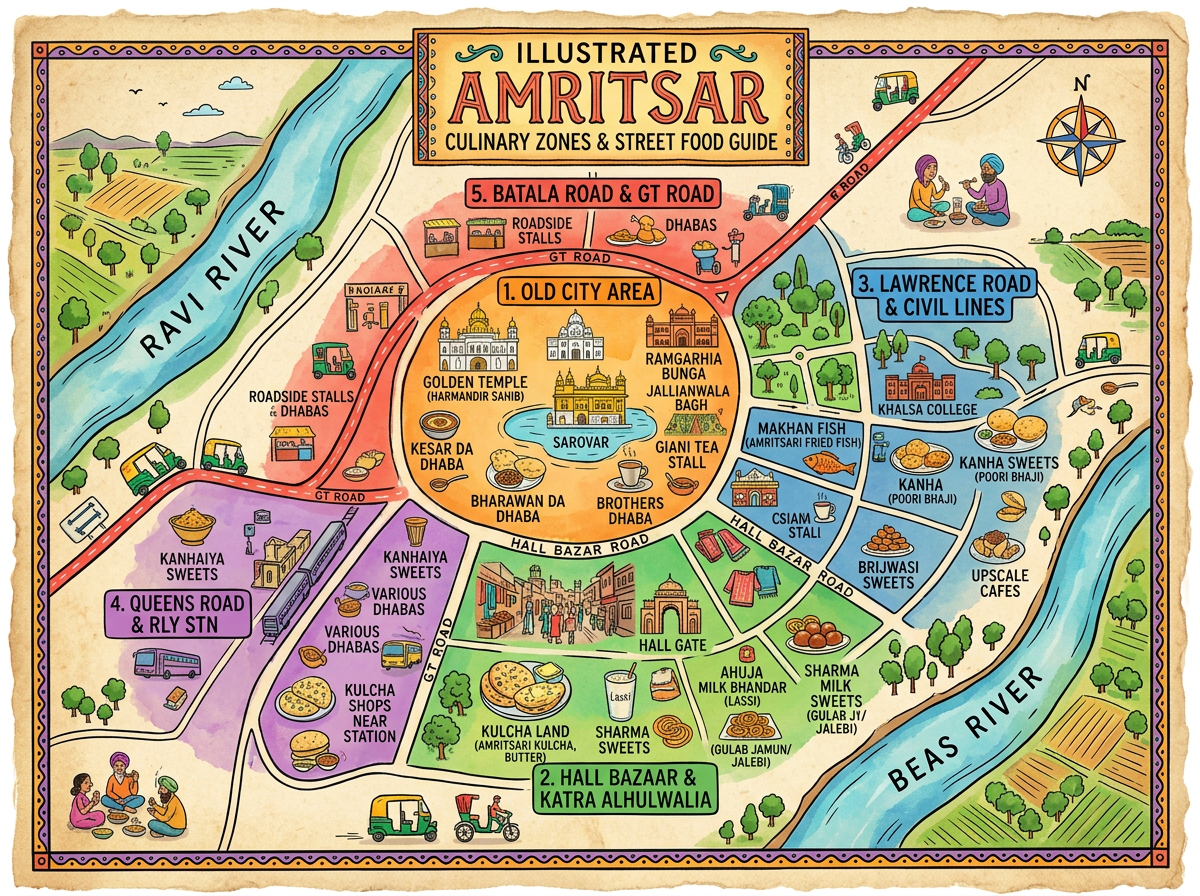
Spatial Gastronomy
The Four Culinary Zones of Amritsar
1. Old Walled City
- Narrow alleys
- Pilgrimage dining
- Vegetarian dominance
- Coal and wood-fire cooking
2. Hall Bazar & City Center
- Traditional market food
- Papad Bazaar
- Quick thalis and snacks
3. Lawrence Road & Mall Road
- Colonial-era suburban food district
- Desserts and premium sweets
- Wealthier demographic
4. Ranjit Avenue & Majitha Road
- Modern carnivore hub
- Spacious family restaurants
- Fish and poultry specialization
Strategic Dining Protocol
Morning (8 AM – 10 AM)
- Kanha Sweets
- Puri Chole
- Satpura
Midday (11 AM – 1:30 PM)
- Golden Temple Langar
Late Lunch (3 PM – 4:30 PM)
- Kesar Da Dhaba
Evening Meat Trail (6:30 PM – 8 PM)
- Sunder Meat Shop
- Makhan Fish
Dessert Finale (9 PM – 10:30 PM)
- A-One Kulfa
- Gurdas Ram Jalebi Wala
Conclusions
The Structural Triad of Amritsari Foodways
1. Spiritualized Dining Culture
The values of langar shaped the egalitarian nature of commercial dining.
2. Refusal to Industrialize
Heritage institutions maintain prestige through:
- Slow cooking
- Coal firing
- Manual preparation
- Resistance to shortcuts
3. Ecological Authenticity
Punjab’s river systems continue to define the authenticity of Amritsari seafood traditions.
The fresh river catch from Beas and Harike Pattan forms the biological foundation of authentic Amritsari Fish.
Final Insight
Amritsar’s food culture is not simply cuisine—it is:
- Theology expressed through hospitality
- Geography translated into flavor
- History preserved through fire, ghee, and grain
The city remains one of the rare global culinary ecosystems where faith, labor, ecology, migration, and memory continue to coexist within everyday dining rituals.
Leave a Reply