
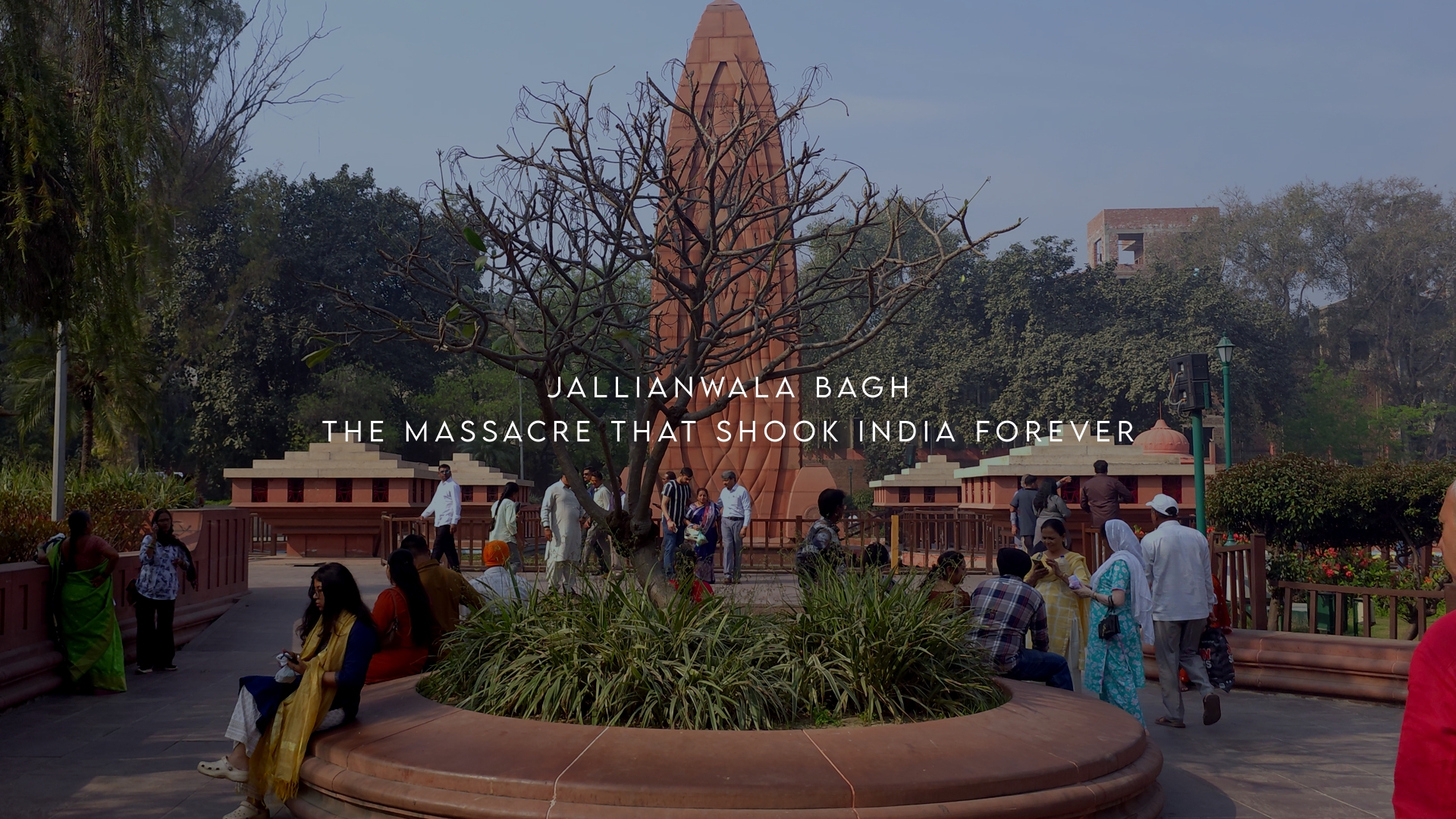
From Colonial Crisis to Contemporary Pilgrimage
The massacre at Jallianwala Bagh on April 13, 1919, stands as one of the most decisive turning points in the history of the British Raj in India. It marked not just an episode of violence, but a profound collapse of colonial legitimacy and the beginning of a more radicalized national movement.
This monograph explores the origins of the tragedy, the execution of the massacre, its institutional and revolutionary consequences, and concludes with a detailed guide for visitors to the site in 2026.
1. Origins of the Crisis: War, Expectations, and Repression
The roots of the tragedy lie in the aftermath of World War I. Between 1914 and 1917, India played a crucial role in supporting the British war effort through manpower and resources. In return, expectations of political concessions grew among Indian leaders and citizens.
However, instead of meaningful reforms, the colonial administration intensified control. The Defence of India Act (1915) had already restricted civil liberties. Meanwhile, nationalist activities such as the Ghadar Movement heightened British anxieties.
The 1916 Lucknow Pact brought unity between the Indian National Congress and the Muslim League, raising hopes of self-governance. Yet, the Montagu–Chelmsford Reforms (1917) fell far short of expectations, fueling widespread dissatisfaction.
2. The Rowlatt Act and the Emergence of Mass Protest
In 1918, the Sedition Committee under Justice Sidney Rowlatt recommended strict measures to curb revolutionary activities. This led to the Anarchical and Revolutionary Crimes Act (1919), widely known as the Rowlatt Act or “Black Act.”
The law allowed detention without trial for up to two years.
This triggered nationwide outrage. Mahatma Gandhi launched a mass protest through Satyagraha, calling for a hartal on April 6, 1919—India’s first large-scale unified protest.
Punjab became the epicenter of resistance due to its political volatility and strategic importance.
3. Punjab Under Tension: Leadership and Crackdown
Sir Michael O’Dwyer, Lieutenant Governor of Punjab, viewed the unrest as a serious threat, possibly linked to foreign influences. He adopted a hardline approach.
Tensions escalated on April 10, 1919, when two popular leaders—Dr. Saifuddin Kitchlew and Dr. Satyapal—were arrested and deported secretly.
Public protests followed. British forces opened fire on demonstrators, leading to deaths and sparking riots. Government buildings were attacked, and violence spread across Amritsar. A British schoolteacher, Marcella Sherwood, was also assaulted during this unrest.
4. Prelude to Tragedy: Military Control and Restrictions
Brigadier General Reginald Dyer arrived in Amritsar and imposed strict controls. Public gatherings were banned.
One of the most humiliating measures—the “crawling order”—forced Indians to crawl through a street where the British woman had been attacked.
These actions created an atmosphere of fear, setting the stage for the events of April 13.
5. The Massacre: April 13, 1919
The Gathering
April 13 coincided with Baisakhi, a major festival. Thousands gathered at Jallianwala Bagh—some for protest, many unaware of restrictions.
The site itself was enclosed, with limited exits, making escape difficult.
The Attack
General Dyer entered with 50 armed soldiers and, without warning, ordered them to fire.
The firing lasted around 10 minutes.
A total of 1,650 rounds were discharged.
Troops targeted the densest sections of the crowd and exit points, maximizing casualties.
6. The Human Toll
Official British figures recorded 379 deaths and over 1,000 injuries.
However, Indian estimates suggested:
- Around 1,000 deaths
- Up to 1,500 casualties
Many victims died attempting to escape, including those who jumped into the Martyrs’ Well.
The scale of suffering was compounded by the lack of medical aid after the firing.
7. Institutional Response: The Hunter Commission
In response to global outrage, the British government formed the Hunter Commission in 1919.
Key Findings
- Dyer’s actions were condemned as excessive
- No organized rebellion was found in Punjab
- Failure to warn civilians was criticized
Despite this, no serious punishment was imposed.
British Political Reaction
In Parliament:
- Winston Churchill called it a “monstrous event”
- The House of Commons condemned Dyer
- The House of Lords defended him
This revealed deep divisions within British society.
8. Revolutionary Impact and National Awakening
The massacre transformed India’s freedom struggle.
Symbolic Acts of Protest
- Rabindranath Tagore renounced his knighthood
- Mahatma Gandhi returned his Kaiser-i-Hind medal
- Several leaders resigned from British positions
This led directly to the Non-Cooperation Movement (1920).
9. Udham Singh and the Pursuit of Justice
Udham Singh, present during the massacre, vowed revenge.
After years of planning, he assassinated Michael O’Dwyer in London in 1940.
He was executed but is remembered as a national hero.
10. Influence on Bhagat Singh
A young Bhagat Singh visited the site after the massacre and collected blood-soaked soil.
This experience shaped his revolutionary ideology and future actions.
11. Evolution of the Memorial (1951–2026)
Jallianwala Bagh was declared a national memorial in 1951.
Key Features
- Flame-shaped memorial (1961)
- Martyrs’ Well
- Preserved bullet marks
- Museum and gallery
Recent Renovations (2019–2021)
Modern upgrades included:
- Redesigned entrance (“Heritage Lane”)
- Landscaping and pathways
- Sound and light show
Criticism
Historians argue that beautification has diluted the site’s emotional gravity, turning it into a tourist-friendly space rather than a place of mourning.
12. Visiting Jallianwala Bagh in 2026
Connectivity
Amritsar is accessible by air, rail, and road.
The memorial is located near the Golden Temple.
Transport Options
- Taxi from airport: ₹110–200
- Auto from railway station: ₹50–80
- Walking distance from Golden Temple
13. Best Time to Visit
- October to March: Ideal weather
- April to June: Extreme heat
- July to September: Monsoon conditions
14. Visitor Information
- Timings: 6:30 AM – 7:30 PM
- Entry Fee: Free
- Museum: 9:00 AM – 6:00 PM
Visitors are expected to maintain silence and respect the sanctity of the site.
15. Nearby Historical Circuit
To fully understand the context, visitors often explore:
- Partition Museum
- Gobindgarh Fort
- Wagah Border
These sites collectively narrate Punjab’s role in India’s history.
16. Conclusion: Memory, Justice, and Legacy
The Jallianwala Bagh massacre is not merely a historical episode—it is a defining symbol of sacrifice and resistance.
It exposed the brutality of colonial power and ignited a nationwide demand for independence.
Today, the site raises an important question:
Can modernization coexist with memory without erasing the pain that shaped a nation?
For every visitor, it remains a powerful reminder of the cost of freedom and the courage of those who stood unarmed in the face of oppression.
Leave a Reply